What’s Inside
- Textured Art: The Best Wall Decor Ideas for Living Room Trends in 2026
- Curate a Biophilic Art Collection
- Hang Art at the Correct Eye Level
- Scale Artwork Appropriately for the Wall
- Create a Dynamic Gallery Wall with Intentional Spacing
- Integrate Decorative Acoustic Panels
- Install Picture Lights to Highlight Key Art
- Opt for Oversized or Grouped Vintage Art
- Utilize Digital Art Frames for Rotating Displays
- Incorporate Floating Shelves with Strategic Spacing
- Avoid Pushing All Furniture Against Walls
- Add Architectural Interest with Paneling
- Layer Textures and Materials for Richness
- Use Mirrors Strategically to Enhance Space
- Be Authentic and Personalize Your Walls
- Mount Woven Baskets for Organic Shapes
- Living Plant Stations: My Favorite Wall Decor Ideas for Living Room Spaces
Last Tuesday, I sat on my living room rug staring at a wall that looked exactly like a bad doctor’s waiting room. I’d just hammered thirteen holes into the drywall trying to hang a gallery wall without measuring, and frankly, I needed some fresh wall decor ideas for living room spaces that actually work. I’m Olivia, and I’ve spent the last six years making every possible decorating mistake so you don’t have to. I bought a cheap canvas from Walmart once that smelled like melting plastic for an entire month. Never again. If your walls are feeling empty, cold, or just slightly off, we’re fixing that today. Skip the generic mass-produced quote signs. They look like hotel lobby filler and add zero personality. Instead, I’m sharing the exact strategies and specific pieces I use to make a room feel finished. I’ve tested the spacing, bought the wrong sizes, and ruined enough paint to know what actually looks high-end. Let’s get into the details.
1. Textured Art: The Best Wall Decor Ideas for Living Room Trends in 2026

Flat walls aren’t in style for 2026. Tactile design is taking over. I’m honestly relieved because flat prints were making my space feel sterile and cold. You want art pieces with physical texture. Think canvas prints with heavy, visible brushstrokes, thick woven wall hangings, or sculptural metal art. I recently got a large-scale abstract piece with a raw linen texture from BIG Wall Décor. It cost $149 for the 40×60 inch size. The fabric actually has a subtle physical relief to it. This adds incredible warmth and depth without creating visual clutter. I tried a cheap, glossy smooth poster from Target first. The glare from my windows made it completely unreadable during the day. Textured wallpaper that gets custom printed with artwork is another massive design shift right now. It absorbs light beautifully instead of reflecting it back into the room. When you touch the wall, you can actually feel the grain of the material. It makes the whole room feel grounded and intentional.
2. Curate a Biophilic Art Collection

Biophilic design is everywhere right now, and it’s heavily influencing the best wall decor ideas for living room updates. This concept just means bringing nature indoors. Choose prints featuring misty scenery, botanical close-ups, or golden forest settings. I bought a canvas piece called “Above the Mist” last October for $85. It features muted palettes of soft grays and warm fog. It sits right above my sofa and instantly lowers my blood pressure when I walk in from work. Metal wall art featuring trees or mountain silhouettes also fits this aesthetic perfectly. They offer durability and a cool sculptural quality. I found a great metal pine tree silhouette at Sprouts of all places for $24.99 while grabbing groceries. It has a rusted, oxidized finish that looks incredibly high-end. I hung it near my window so the afternoon light casts sharp shadows through the metal branches onto the drywall. It’s a small detail, but it makes the room feel deeply connected to the outdoors.
3. Hang Art at the Correct Eye Level

Most people get this basic measurement wrong. I used to be one of them. A common mistake is hanging art way too high. You end up craning your neck like you’re staring at a highway billboard. Interior designers strictly recommend positioning the center of your artwork between 57 to 60 inches from the floor. This is the exact average eye level for a standing adult. I spent months wondering why my living room felt disjointed until I took a tape measure and realized my main painting was centered at 72 inches. I moved it down to 58 inches. The entire room instantly clicked into place. This rule ensures the art feels integrated into the room rather than floating awkwardly near the ceiling molding. If you’re hanging a piece above a sofa, the bottom of the frame should be exactly 8 to 10 inches above the back of the couch. Any higher, and the art completely detaches from the furniture grouping below it.

3 Pack Metal Mirrors for Wall Sunburst Wall Mirrors Home
3 Pack Metal Mirrors for Wall Sunburst Wall Mirrors Home Décor Decorat punches above its price — 2 buyers rated it 4.5 stars. I would buy it again.
4. Scale Artwork Appropriately for the Wall

Please avoid the mistake of using art that is way too small for a large wall. It makes the piece look lost, sad, and cheap. For a blank wall, your art should ideally take up 60% to 75% of the available wall space. If you’re hanging art above furniture, the piece should be approximately two-thirds to three-quarters the width of the furniture it sits above. I learned this the hard way when I bought a 16×20 inch frame from Kroger for $12.99 and stuck it alone on a massive 12-foot wall. It looked like a tiny postage stamp. I ended up returning it and buying a massive 48×60 inch canvas instead. Yes, large art costs more upfront. But it’s ultimately cheaper than buying ten small pieces that look cluttered and chaotic. Measure your wall, multiply the width by 0.60, and use that number as your minimum artwork width. It takes the frustrating guesswork completely out of the equation.
5. Create a Dynamic Gallery Wall with Intentional Spacing

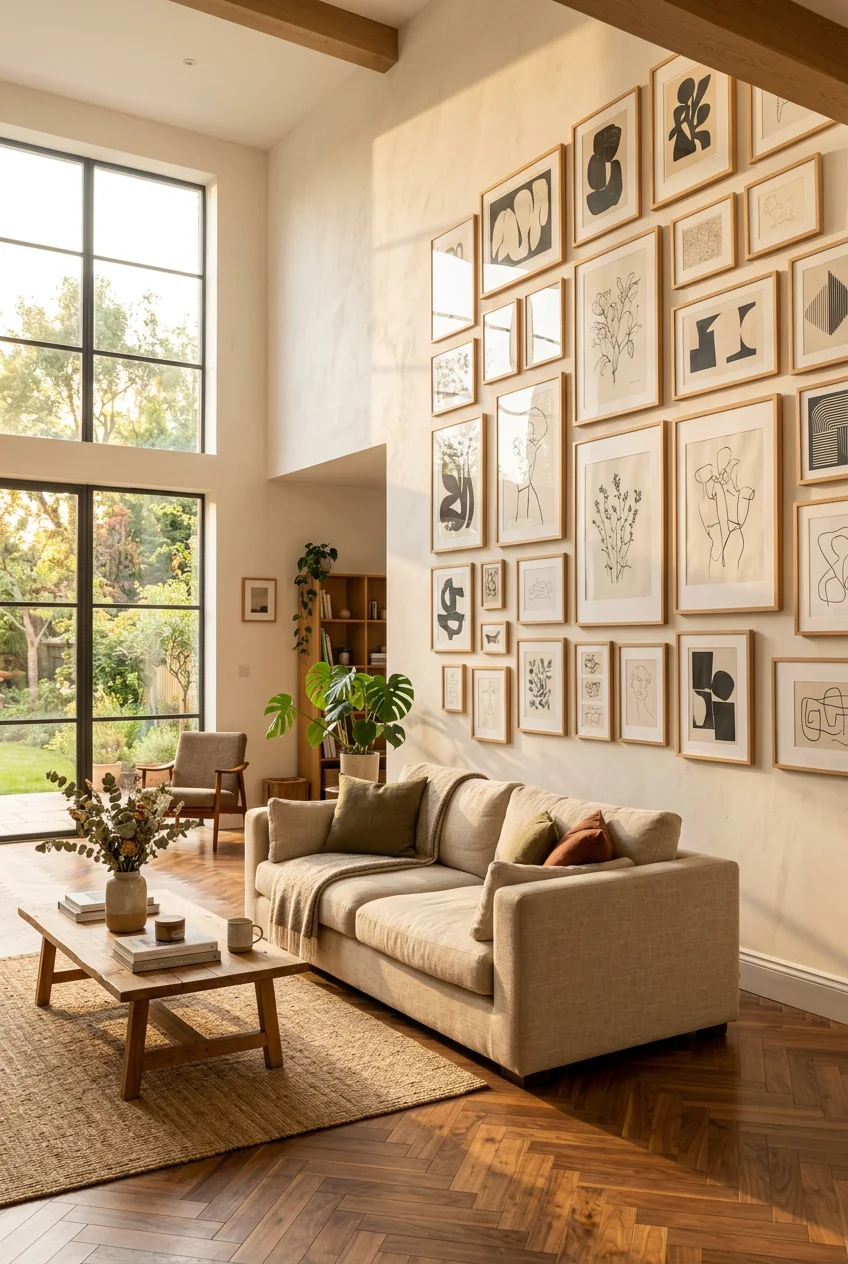
You can easily turn an empty wall into a curated gallery, but you need strict rules for spacing. When arranging multiple pieces, maintain consistent spacing of exactly 3 to 6 inches between frames to ensure a cohesive look. I usually stick to exactly 2.5 inches because I prefer a tighter, more modern grid. Always lay out your arrangement on the floor first to visualize the composition before making any holes. I use blue painter’s tape to mark the exact dimensions on my rug. I bought a set of seven matching black frames from Costco for $39.99 last month. I traced them onto old newspaper, cut out the paper templates, and taped them directly to the wall. It saved me from patching drywall later when I inevitably changed my mind. If your spacing is uneven, the gallery wall looks messy rather than intentional. Keep the gaps perfectly uniform, even if the frames themselves are different sizes and shapes. You might also like: 20 Beautiful Home Decor Ideas for Any Style
6. Integrate Decorative Acoustic Panels

This is a lesser-known tip that completely fixes a loud, echoey room. Beyond basic aesthetics, decorative acoustic panels significantly reduce noise in a living room. This is a huge focus for 2026 wellness-centered spaces. If you have hardwood floors and high ceilings, your room probably echoes terribly. Brands like Acoustimac and GIK Acoustics offer customizable panels where you can upload your own artwork or choose from their galleries. You’re effectively combining sound treatment with personalized decor. Prices vary widely based on size and customization. A single 24×48 inch panel usually ranges from $100 to $300. I bought two panels from GIK Acoustics for $145 each and printed my own black and white photography on them. The fabric cover is breathable, hiding the dense sound-absorbing fiberglass core inside. My living room finally sounds warm and muffled, rather than like a noisy high school gymnasium. You won’t believe the difference in sound quality when watching movies. You might also like: 18 Rustic Living Room Decor for Every Budget

Arched Wall Mirror Vintage
If you want something that just works, Arched Wall Mirror Vintage – 24″X36″ Large Retro Silver Scalloped Bead is a safe bet.
7. Install Picture Lights to Highlight Key Art

You can upgrade your favorite artwork instantly by installing picture lights above the frames. These fixtures add a museum-like quality and incredible evening ambiance to any space. Brands like Visual Comfort, House of Troy, or WAC Lighting make beautiful brass and matte black options. You need to position the fixture exactly 6 to 8 inches above the top of the frame. Choose a light that spans 50% to 75% of the artwork’s width for even, flattering illumination. I bought a 14-inch brass battery-operated picture light from Amazon for $45.99 because I didn’t want to hire an electrician to hardwire anything. It uses LED bulbs, which is absolutely crucial. Old halogen lights get way too hot and will absolutely damage your artwork over time. The LED casts a warm 2700K glow over my canvas. I turn it on every evening at 6 PM. It creates this moody, sophisticated shadow play on the wall that standard overhead lighting just can’t replicate. You might also like: 20 Cozy Aesthetic Cozy Home Decor That Make a Real Difference
8. Opt for Oversized or Grouped Vintage Art

Vintage art continues to trend heavily in 2026, with a strong focus on grouped or oversized pieces. Look for old oil paintings, moody portraits, or nature scenes with muted, muddy tones. The frames should be aged, chipped, or slightly imperfect to add instant depth and a collected feel to your space. This approach adds massive character and personal expression. It moves far away from sterile minimalism. I found a massive 36×48 inch vintage seascape at a dusty flea market last summer for $65. The gold leaf frame was flaking off in the bottom corners, but I left it exactly as is. I hung it alone on my dining room wall, and it commands the entire space. If you can’t find one large piece, group three or four smaller vintage portraits together. I sometimes scour the aisles at Whole Foods for their seasonal floral bouquets, dry them out for two weeks, and press them into vintage brass frames I find at antique stores.
9. Utilize Digital Art Frames for Rotating Displays

For a modern and versatile approach, you really should consider a digital art frame. The SwitchBot AI Art Frame is a massive 2026 trend. It uses color e-ink displays that consume zero power once an image is set. This allows for months of battery life and a completely cord-free look on your wall. Other options like the Aura Aspen or Meural Canvas II offer high-resolution displays for vibrant rotating art collections. Prices for quality frames typically start around $200 to $300. I bought the 15-inch Aura frame for $299 last November. I initially hated the idea of digital frames because early versions looked like glowing computer monitors in the dark. But the matte anti-glare finish on these new models is incredible. They genuinely look like real canvas. I have mine set to rotate through vintage botanical prints every morning at 8 AM. It satisfies my need to constantly change my decor without buying new physical prints every single month.

PERFNIQUE Irregular Wall Mirror Asymmetrical Mirror
If you want something that just works, PERFNIQUE Irregular Wall Mirror Asymmetrical Mirror is a safe bet (633 reviews, 4.5 stars).
10. Incorporate Floating Shelves with Strategic Spacing

Floating shelves offer both display space and architectural interest. But spacing is everything. For general display, space your shelves 12 to 18 inches apart vertically. If you’re displaying smaller items like candles or trailing plants, 8 to 12 inches apart works perfectly. For shelves above a sofa, aim for 10 to 15 inches above the back of the couch. Brands like Tailor Wood Haven offer minimalist White Oak floating shelves. Peter’s Goods has beautiful Rustic Live Edge options. A 36-inch length usually runs $400 to $1110 depending on the exact wood species and hidden bracket system. I installed two 48-inch walnut shelves in my living room last spring. I initially hung them 24 inches apart, and they looked completely disconnected. I had to patch the drywall and lower the top shelf to a 14-inch gap. Now they look like a cohesive unit holding my heavy ceramic vases and stacked design books. Always double-check your vertical spacing before drilling.
11. Avoid Pushing All Furniture Against Walls

This feels like a furniture tip, but it directly impacts your wall decor. A common decorating mistake is pushing all your furniture flat against the walls. It creates a weird bowling alley effect in the center of the room and makes the walls feel miles away. Instead, arrange your furniture from the center out. Create conversational groupings and allow for visual flow behind the sofa. When you pull the sofa three feet away from the wall, you create a dedicated walking corridor. This helps define zones and makes the space feel more intentional. It also brings your seating closer to the wall decor on the opposite side of the room. This makes the art feel more intimate and viewable. I used to have my heavy sectional shoved into the corner. I pulled it out 18 inches. Suddenly my gallery wall didn’t feel like it was floating in outer space. The whole room felt cozier and properly proportioned.
12. Add Architectural Interest with Paneling

In 2026, classic architectural details like picture-frame wall paneling and crown moldings are making a massive comeback. This adds a sense of history and depth to a room. It creates a sophisticated backdrop for your decor without a full gut renovation. It’s a more permanent wall decor solution that provides a high-end, custom look. I tackled a DIY picture-frame molding project last winter using precut trim from Home Depot. The pine trim cost about $1.15 per linear foot. I mapped out three large rectangular boxes on my main living room wall, nailed them in, and painted everything in a monochromatic dark green. I used Sherwin Williams Pewter Green in a matte finish. The shadows cast by the raised molding add so much texture that I barely needed to hang any art inside the boxes. If you’re tired of staring at flat drywall, installing applied molding takes a weekend and completely changes the structural feel of the room.

Jexine 4 Pcs Hanging Planters with Artificial Eucalyptus
Jexine 4 Pcs Hanging Planters with Artificial Eucalyptus Metal Hanging punches above its price — 12 buyers rated it 4.5 stars. I would buy it again.
13. Layer Textures and Materials for Richness

Moving away from stark minimalism, current trends emphasize heavy textural layering. You need to combine materials like linen, wood, metal, boucle, velvet, rattan, and natural wool in your wall decor. A large woven wall hanging can introduce bohemian texture instantly. You can usually find these for $50 to $200 depending on the knot complexity and size. I bought a massive 40-inch wide woven wool piece for $120. It completely softened the hard, cold edges of my brick fireplace. Consider a framed piece with a fluted glass front for added dimension. I also love mixing in organic elements. I bought a small woven basket from Walmart for $8.99, cut it in half with heavy shears, and mounted it flush to the wall as a pocket planter for dried eucalyptus. The smell is amazing. Mixing soft textiles with hard metals and warm woods prevents the wall from looking flat and catalog-perfect.
14. Use Mirrors Strategically to Enhance Space

Decorative mirrors do double duty. They fill blank wall space and make a room feel significantly larger and brighter. You can use a single large statement mirror or create a gallery wall of smaller vintage mirrors. For an antique touch, look for mirrors with aged or ornate brass frames. This aligns with the 2026 trend for character-filled pieces. I bought a heavy 3×3 foot arched mirror for $149 and leaned it heavily on my mantel. It bounces the afternoon light from my south-facing window directly into the darkest corner of the room. Don’t just hang a mirror randomly, though. Pay attention to exactly what it reflects. I once hung a gorgeous vintage mirror only to realize it perfectly reflected my messy kitchen sink full of dishes. I moved it to the opposite wall so it reflects my indoor olive tree instead. Always check the reflection angle before you drill the hole.
15. Be Authentic and Personalize Your Walls

The biggest wall decor trend of 2026 is pure authenticity. It’s about curating spaces that reflect your actual identity rather than following a rigid Pinterest aesthetic. This “identity decor” movement celebrates individuality. Instead of generic wall decals or mass-produced signs that say “Gather,” choose art, photography, or sentimental decor that tells your personal story. I framed a series of handwritten recipe cards from my grandmother. I placed them in floating glass frames so you can see the aged paper edges on both sides. I also hung a battered acoustic guitar my husband learned to play on in college. It sits on a cheap $15 wall mount and looks incredibly sculptural. Stop buying filler pieces just to cover blank drywall. If a piece doesn’t mean anything to you, leave the wall blank until you find something that does. Empty space is always better than meaningless clutter.

3D Wooden Floral Bathroom Wall Decor (Set of 4) Lightweight
3D Wooden Floral Bathroom Wall Decor (Set of 4) Lightweight punches above its price — 634 buyers rated it 4.5 stars. I would buy it again.
16. Mount Woven Baskets for Organic Shapes

If you want an inexpensive way to cover a massive amount of wall space, woven baskets are the answer. African Binga baskets or flat woven rattan trays add incredible organic shapes to rigid, boxy rooms. I started collecting shallow woven bowls from thrift stores for about $3 to $5 each. I even found a beautiful two-toned seagrass basket at Target for $15.99 that I added to the cluster. To hang them, I just thread a simple needle and clear fishing line through the center weave, tie a tight loop, and hang it on a standard picture nail. I arranged a cluster of nine baskets over my console table. The varying depths and natural grass tones create a stunning 3D effect. The mistake people make here is spreading them out too far. You want the edges of the baskets to slightly overlap each other. It makes the arrangement look like one cohesive art installation rather than scattered frisbees.
17. Living Plant Stations: My Favorite Wall Decor Ideas for Living Room Spaces

Plant lovers, this one completely fixes the problem of having too many pots crowding your window sills. Wall-mounted propagation stations act as living, breathing wall decor. You mount a wooden backboard that holds slender glass test tubes filled with water and plant cuttings. I bought a beautiful solid walnut three-tube station from a local maker for $35. I regularly clip pothos vines from my main trailing plants and stick them right in the tubes. The white roots look fascinating as they grow through the clear glass, and the bright green leaves pop heavily against my white walls. I grab fresh eucalyptus stems from Trader Joe’s for $3.99 a bunch and keep them in the wall vases when I don’t have any plant cuttings ready. It requires a tiny bit of maintenance since you have to top off the tap water every few weeks. But the visual payoff of having living art on your walls is unmatched. Plus, you get free baby plants out of the deal.
Decorating your walls shouldn’t feel like a high-pressure final exam. I tried forcing my living room to look like a specific high-end catalog for years before I realized it just made the space feel incredibly stiff and uninviting. Start with one single wall. Hang that vintage painting you found, measure your gallery spacing twice, and skip the mass-produced filler art. I’d highly recommend starting with the paper template trick for any gallery layout. It saves so much drywall patching and frustration. If you found these tips helpful, pin this post to your home decor board so you have all the exact measurements and spacing rules handy for your next weekend project. You’re going to love how your space feels once you get the scale right.
Frequently Asked Questions
How high should I hang wall decor in my living room?
Always hang your art so the center of the piece sits exactly 57 to 60 inches from the floor. If you’re hanging it above a sofa, ensure the bottom of the frame is 8 to 10 inches above the backrest.
What size art do I need for a large living room wall?
Your artwork should fill about 60% to 75% of the empty wall space. If placing it over furniture, the piece needs to be two-thirds to three-quarters the width of the furniture below it so it doesn’t look lost.
How much space should be between gallery wall frames?
Keep the spacing between your frames tight and consistent. Aim for exactly 3 to 6 inches between each piece. I typically use a 2.5 to 3-inch gap for a clean, modern look. Always use a paper template first.
What are the best wall decor ideas for living room spaces in 2026?
The biggest trends include heavily textured canvas art, biophilic nature prints, decorative acoustic panels for sound dampening, and authentic vintage portraits. People are moving away from flat mass-produced signs toward pieces with physical depth and personal meaning.
