What’s Inside
- Start With A Warm Minimalist Palette
- Buy Leggy, Low-Profile Furniture
- Use Modular Sofas For Awkward Layouts
- Take Your Shelving All The Way Up
- Hide Clutter In Multifunctional Pieces
- Layer Your Lighting Strategically
- Bounce Light With Oversized Mirrors
- Anchor The Space With An 8×10 Rug
- Hang Curtains High And Wide
- Stop Pushing Furniture Against The Walls
- Soften Harsh Angles With Curved Decor
- Try Color Drenching For Depth
- Hide The Ugly Tech Cables
- Swap To An Acrylic Coffee Table
- Ditch Side Tables For C-Tables
- Use Plants To Blur Hard Corners
- Mount Your TV And Console
- Layer Rugs For Cozy Texture
- Hang One Massive Piece Of Art
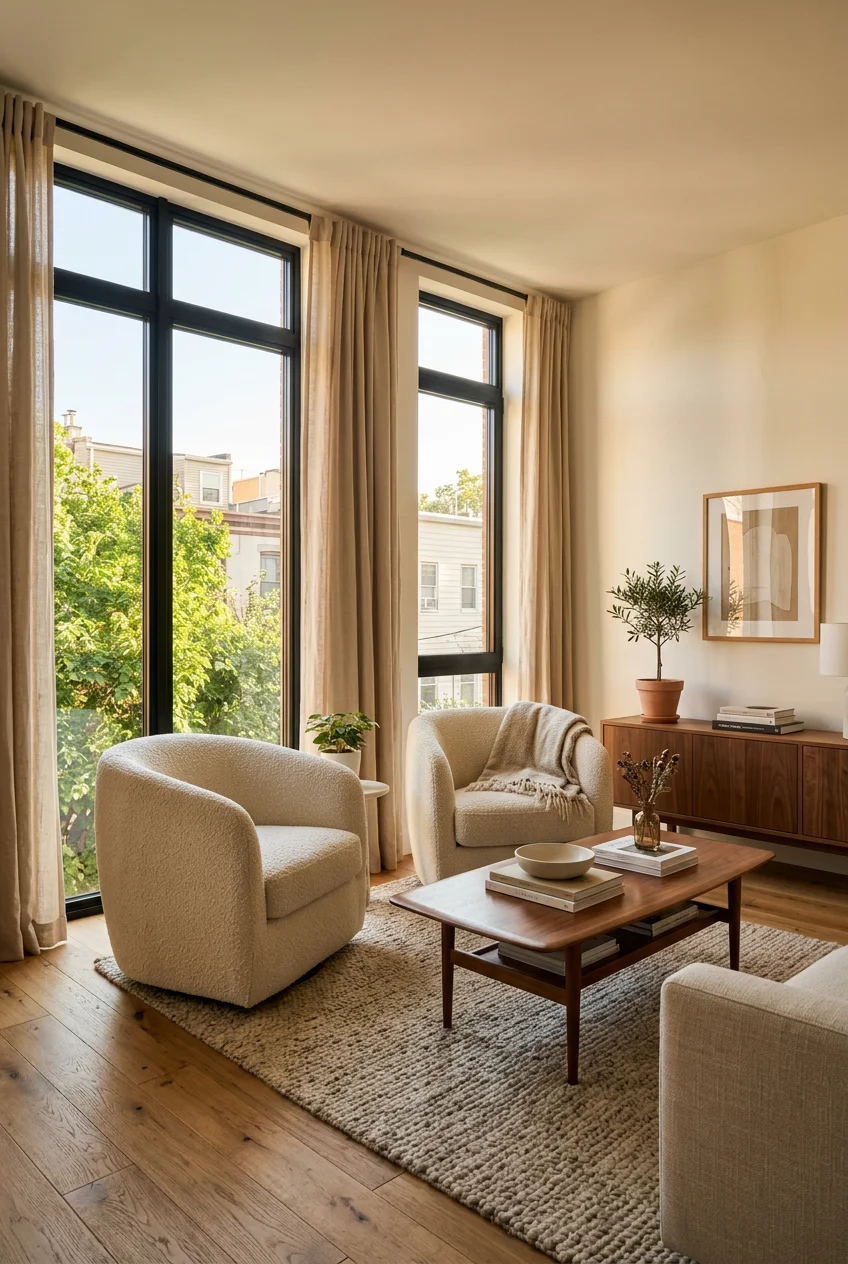
I spent my first three years in a 400-square-foot Brooklyn studio tripping over a bulky $400 Ashley Furniture sofa before I figured out how to actually layout a small living room. I bought a massive gray sectional thinking it’d make the space cozy. Instead, it blocked the only window and smelled faintly of damp cardboard every time it rained—learned that the hard way. Small apartment design isn’t about buying miniature furniture. It’s about strategic math and tricking the eye. I’ve spent the last six years as a stylist fixing cramped layouts. I’m going to share exactly what works, down to the specific measurements and paint colors.
1. Start With A Warm Minimalist Palette

Most people paint tiny rooms stark hospital white thinking it creates space. I tried this in 2019. My living room felt like a sterile dentist waiting area. For a solid foundation, you need warm undertones to reflect light without feeling cold. I use Benjamin Moore’s White Dove. It costs about $75 a gallon. It’s got a creamy, soft base that bounces sunlight around beautifully. If you want something slightly deeper, Sherwin-Williams Alabaster is excellent. Pair these walls with oatmeal-colored textiles and sand-toned sofas. I bought a 50-inch sand-colored linen throw from Target last month for $24.99 to drape over my chair. It instantly warmed up the corner and hid a coffee stain on the cushion. Skip the cool grays entirely. They just make tight spaces look like concrete bunkers and drain the color from your skin.
2. Buy Leggy, Low-Profile Furniture

A sofa sitting flush on the floor eats your square footage. You need light and air to flow underneath your pieces to trick the brain into seeing more floor space. I learned this when I swapped my skirted couch for the Castlery Adams sofa ($1,299). It sits exactly 15cm off the ground on slim, tapered wooden legs. The difference was immediate. The ceiling suddenly felt six inches taller. When you’re shopping at places like West Elm or even browsing the aisles at Walmart, measure the leg height. You want at least 15cm of clearance. Avoid thick, rolled arms that take up 10 inches of usable seating space. Slim arms and low backs keep the sightlines open across the room. Pro tip: run your tape measure from the floor to the bottom frame. If it’s under 10cm, don’t buy it.
3. Use Modular Sofas For Awkward Layouts

Standard three-seater sofas rarely fit up narrow apartment stairwells. I once had to pay a delivery crew $150 extra just to pivot a couch through my doorway, and they still scratched the paint. Now, I strictly recommend modular seating. The Albany Park Kova L-Shape starts around $1,400 and ships in separate boxes. You can carry the pieces up yourself. If your space is under 85 inches wide, start with a compact two-seater module. You can always add a corner piece later when you move. The IKEA FRIHETEN sleeper sofa is another solid option for $799. It doubles as a guest bed and holds three extra blankets in the chaise storage compartment. The fabric is slightly scratchy on bare legs, but the utility makes up for it. Just check the exact dimensions before ordering.

KHOYIME Large Macrame Wall Hanging Boho Woven Tapestry
KHOYIME Large Macrame Wall Hanging Boho Woven Tapestry punches above its price — 994 buyers rated it 4.5 stars. I would buy it again.
4. Take Your Shelving All The Way Up

Leaving the top two feet of your walls empty is a massive waste of real estate. I install continuous perimeter shelving 30cm below the ceiling in almost every client’s apartment. I buy the Nathan James floating wood shelves. They cost $49.99 each on Amazon. I line them across the entire back wall. This airspace storage holds my heavy art books and ugly Wi-Fi routers perfectly out of sight. It draws the eye upward, making the room feel significantly taller. Just make sure you use proper drywall anchors. I used cheap plastic ones once and a stack of magazines ripped a two-inch hole in my wall. Buy the metal toggle bolts. They cost $4 at Home Depot and hold 50 pounds. It takes an extra ten minutes to install, but it prevents drywall disasters.
5. Hide Clutter In Multifunctional Pieces

Every item in a tight room needs a second job. Single-use furniture is a luxury you can’t afford here. I keep a Castlery Harper Lift-Top Coffee Table in my current setup. It costs $599. The top pulls up to a perfect 24-inch height for my laptop, and the inside hides my ugly PlayStation controllers and a 16 oz bottle of screen cleaner. I also use a hollow faux-leather storage ottoman from Target ($60). It holds two spare throw blankets. When guests come over, I drag it out for extra seating. Don’t buy those flimsy fabric cubes. They collapse if someone weighing over 100 pounds sits on them. Invest in solid wood frames. A common mistake is buying tiny decorative stools that just add visual clutter without offering any hidden storage capacity.
6. Layer Your Lighting Strategically

Relying solely on your apartment’s harsh overhead dome light makes the room look flat and depressing. I never use the ceiling fixture. Instead, I use three different light sources to create depth. I place a slim brass floor lamp in the corner for ambient light. I keep a small $35 ceramic table lamp from Target on my console for task lighting. For accent lighting, I stick battery-operated wall sconces behind the sofa. You can find packs of two for $45 online. I put Philips Hue smart bulbs ($49 each) in all of them. I set the app to cool white (4000K) when I’m reading at 2 PM. At 7 PM, I switch everything to a warm, dim 2700K. It completely changes the mood of the room. Don’t skip the smart bulbs. The color temperature control is crucial.

3D Wooden Floral Bathroom Wall Decor (Set of 4) Lightweight
Honestly, 3D Wooden Floral Bathroom Wall Decor (Set of 4) Lightweight surprised me — sturdier than it looks in the photos, and over 634 buyers gave it 4.5 stars.
7. Bounce Light With Oversized Mirrors

A tiny room with one window feels like a cave. You can double your natural light with a $150 Target Threshold arched mirror. I bought the 70-inch floor version last Tuesday at Whole Foods (they surprisingly had a home section pop-up) but ended up returning it for the Target one because the brass frame looked less cheap. Place it on the wall directly opposite your only window. It acts like a second window. Make sure it reflects something nice. I once angled a mirror poorly and it just highlighted my overflowing laundry basket in the hallway. I had to stare at my dirty socks all week until I realized the mistake and shifted the frame three inches to the left. Always check the reflection angle before you drill the mounting holes.
8. Anchor The Space With An 8×10 Rug

People always buy 5×7 rugs for small rooms because they think a small room needs a small rug. This is completely backwards. A tiny rug floating in the middle of the floor chops the room up into visual postage stamps. You need an 8×10 foot rug. It typically costs around $200 to $400 depending on the brand. I use a washable Ruggable one. You want the front legs of your sofa and your accent chairs to sit at least six inches onto the fabric. This connects all the furniture together into one cohesive zone. I bought a cheap 5×7 rug from Walmart five years ago. It looked like a bath mat sitting under my coffee table. Sizing up fixed the entire layout. Don’t skimp on rug dimensions to save fifty bucks.
9. Hang Curtains High And Wide

Apartment windows are usually tiny and awkwardly placed. You can fake architectural grandeur with a $15 curtain rod. Mount the rod at least 20cm above the actual window frame, right below the ceiling line. Extend the rod 15cm past the window edges on both sides. I use the IKEA Ritva curtains. A pair costs $39.99 and they look like custom linen. When you push the curtains open, the fabric should rest against the wall, not blocking the glass. This lets in 100 percent of the sunlight and tricks your brain into thinking the window is massive. I hem mine with iron-on tape so they barely kiss the floor. Puddled curtains just collect dust and dog hair. A common mistake is hanging the rod directly on the window trim. It shrinks the room instantly. You might also like: 15 Lovely Cozy Home Decor Ideas to Steal Right Now

Jexine 4 Pcs Hanging Planters with Artificial Eucalyptus
Jexine 4 Pcs Hanging Planters with Artificial Eucalyptus Metal Hanging punches above its price — 12 buyers rated it 4.5 stars. I would buy it again.
10. Stop Pushing Furniture Against The Walls

Lining all your furniture up against the perimeter creates a weird dance floor in the middle of your living room. It feels uninviting. Pull your sofa exactly 10cm away from the wall. This tiny gap of shadow gives the furniture visual breathing room. I did this in my last apartment and my landlord asked if I knocked down a wall. It just improves the traffic flow. If you have an armchair, angle it slightly into the room instead of shoving it flat into a corner. I keep a 6-foot faux olive tree from Costco ($45) behind my floating chair. The leaves fill the empty corner space perfectly without adding heavy visual weight to the floor plan. You might also like: 19 Living Room Decor Apartment Worth Trying
11. Soften Harsh Angles With Curved Decor

Small rooms are just rigid boxes. If you fill a box with more rectangular boxes (square sofas, square tables, square rugs), it feels claustrophobic. You need organic shapes to break up the grid. I swapped my sharp rectangular coffee table for a kidney-bean shaped wood table I found for $120. No more bruising my shins when squeezing past it. I also added a West Elm arched floor lamp ($299) that swoops over the sofa. The sweeping curve draws your eye across the room. Even adding a simple round velvet pillow from Target ($20) to your rigid sofa helps. The eye naturally follows curves, which makes the space feel more fluid and less like a storage container. Avoid sharp 90-degree angles on your accent pieces whenever possible. You might also like: 16 Apartment Bathroom Decor Ideas Worth Trying
12. Try Color Drenching For Depth

If you’re brave enough to paint, skip the accent wall. Accent walls chop a small room in half. Instead, try color drenching. This means painting the walls, the baseboards, the window trim, and the doors all the exact same color. I used Sherwin-Williams Naval (a deep navy blue) in a client’s 300-square-foot studio. It cost about $150 in paint supplies. By removing the white trim borders, your eye doesn’t register where the walls stop and start. The corners melt away. It sounds terrifying to paint a tiny room dark blue, but it creates a cozy, jewel-box effect. Just make sure you use a flat or matte finish for the walls and a satin finish for the trim to add subtle texture.

FAEKSUR Framed Abstract Neutral Wall Art for Living Room
If you want something that just works, FAEKSUR Framed Abstract Neutral Wall Art for Living Room is a safe bet (1 reviews, 4.5 stars).
13. Hide The Ugly Tech Cables

Nothing ruins a carefully styled room faster than a tangled black nest of HDMI cords and extension cables. Visual clutter shrinks a room instantly. I spent two hours last weekend zip-tying every wire behind my TV. I use a closed-door media console from IKEA (the Besta unit, $250). I drilled a 2-inch hole in the back panel to route the cables straight into the wall outlet. I keep my router, cords, and a bulky power strip hidden inside. I even bought a $15 cable management box from Amazon to hide the phone chargers next to my sofa. If you can see a wire, you need to hide it. The visual silence it creates is worth the effort.
14. Swap To An Acrylic Coffee Table

Solid wood coffee tables are heavy visual anchors. In a tight layout, they block your view of the rug and make the seating area feel crowded. I use a clear acrylic waterfall coffee table. I bought mine for $189 online. Because it’s completely transparent, your eye travels right through it to the floor. It provides a 38-inch surface for my coffee mugs and magazines without taking up any perceived space. The only downside is the constant smudges. I have to wipe it down with a microfiber cloth and a $4 bottle of Windex every three days. If you hate cleaning, a glass table with a thin metal frame offers a similar transparent effect with slightly less fingerprint maintenance.
15. Ditch Side Tables For C-Tables

Traditional end tables require at least 18 inches of floor space next to your sofa. Most small apartments don’t have that luxury. I completely abandoned side tables three years ago. Now, I exclusively use C-tables. These are clever little accent tables shaped like the letter C. The base slides directly under the sofa frame, and the top hovers right over the armrest. I bought a wood and iron one from Target for $45. It takes up zero extra floor footprint. I use it to hold my 12 oz coffee mug in the morning and my laptop at night. When I’m done, I just push it tight against the sofa. It’s the smartest $45 I’ve ever spent on furniture—took me years to figure out.
HK Studio Hippie Decor, Posters for Room Aesthetic
HK Studio Hippie Decor punches above its price — 348 buyers rated it 4.5 stars. I would buy it again.
16. Use Plants To Blur Hard Corners

Empty corners in a square room highlight exactly where the space ends. You can blur these boundaries with tall, leafy plants. I bought a massive Bird of Paradise from Trader Joe’s for $19.99 last spring. I put it in a $30 ceramic pot and shoved it into the darkest corner of my living room. The large, arching leaves spread out and hide the sharp 90-degree angle of the walls. It creates an illusion of depth, making it feel like the room continues behind the foliage. Just don’t clutter the floor with ten tiny succulent pots. One large statement plant does a much better job of expanding the space than a chaotic collection of small ones.
17. Mount Your TV And Console

Floor space is your most valuable asset. Anything resting on the ground is stealing from you. I always mount the television directly to the studs. I use a $35 tilting bracket from Walmart. But don’t stop there. Mount the TV console to the wall too. A floating media cabinet hovering 20cm off the ground creates the same airy illusion as a leggy sofa. I used a two-door cabinet unit and secured it with heavy-duty French cleats. It cost me about $120 total. Now, I can slide two flat woven baskets underneath it for extra shoe storage. Plus, running the vacuum underneath is completely effortless. Just make sure you use a stud finder. Drywall won’t hold a cabinet.
18. Layer Rugs For Cozy Texture

Sometimes you’re stuck with ugly apartment carpeting that you aren’t allowed to rip out. My second apartment had a stained beige carpet that depressed me daily. You can fix this by layering a large area rug right over the carpet. I bought a flat-weave 8×10 jute rug from Costco for $120 and threw it down. Then, I layered a smaller 5×7 vintage-style runner on top of it. The double layer completely distracted from the cheap apartment flooring. The jute added a natural, grounding texture, while the top rug added color. You just need a roll of double-sided carpet tape ($8) to keep the top rug from buckling when you walk across it.
19. Hang One Massive Piece Of Art

Gallery walls look incredibly cluttered in a small room. A grid of fifteen tiny frames just adds visual noise and makes the walls feel crowded. I made this mistake trying to display all my $5 Etsy prints. The room felt like a chaotic dorm. I took them all down and bought a single 40×60 inch canvas from Minted for $350. I hung it right above the sofa. One oversized piece of art acts like a focal point and gives the room a sense of scale. It commands attention without busy details. If large art is too expensive, you can buy a 36-inch blank canvas from an art supply store for $40 and paint a simple abstract block of color yourself. Stick to one large piece per wall to keep the layout clean.
Decorating a tiny space doesn’t mean sacrificing your personal style or living in a sterile box. It just takes a little math and a lot of measuring tape. I tried forcing giant furniture into tiny rooms for years before I finally accepted these rules. Now, my small living room feels like a boutique hotel lounge instead of a storage unit—no exaggeration. If you’re currently staring at a cramped layout, pick just three of these tips to start with this weekend. I’d highly recommend starting with the lighting and the C-table. Pin this guide so you can reference the exact measurements next time you’re standing in the Target furniture aisle trying to make a decision.
Frequently Asked Questions
How do I arrange furniture in a small apartment living room?
Stop pushing furniture flat against the walls. Pull your sofa 10cm away from the wall to create visual breathing room. Use an 8×10 rug to anchor the seating area, and opt for a C-table instead of bulky side tables to save floor space.
What colors make a small living room look bigger?
Warm, creamy whites like Benjamin Moore’s White Dove reflect light beautifully without feeling sterile. Alternatively, you can try color drenching—painting the walls and trim the same dark color, like navy blue, to blur the corners and create a cozy, expansive illusion.
How can I maximize storage in a tiny living room?
Use multifunctional furniture like a lift-top coffee table or a solid wood storage ottoman. Install floating shelves 30cm below the ceiling across the perimeter of the room to store books and decor without eating up valuable floor space.
What type of sofa is best for a small apartment?
A modular sofa with slim arms and exposed legs is best. You want legs that lift the frame at least 15cm off the floor to let light pass underneath. Modular pieces also make it easier to navigate narrow apartment stairwells during move-in.
