What’s Inside
- Invest in a Classic Solid Wood Bed Frame
- Enforce Strict Symmetry with Nightstands and Lamps
- Execute Color-Drenching with Rich, Layered Hues
- Hang Floor-Length Luxurious Curtains Properly
- Anchor the Space with a Substantial Area Rug
- Layer Bedding for Authentic Traditional Bedroom Decor
- Stop Buying Matching Bedroom Furniture Sets
- Ground the Room with Vintage Accents and Heirlooms
- Build Multiple Layers of Lighting
- Master Proper Bed Placement and Height
- Add a Chaise Lounge or Love Seat
- Add Architectural Interest to the Ceiling
- Practice Texture-Maxxing for Sensory Richness
- Introduce Muted Illustrated Statement Rugs
- Create an Analog Space for Better Sleep
- Install Classic Brass Hardware on Dressers
- Display Real Books on Solid Wood Bookshelves
Last Tuesday, I sat on the floor of my guest room surrounded by six different shades of beige paint samples. I realized my attempt at traditional bedroom decor looked exactly like a cheap motel. True traditional bedroom decor requires specific layering, not just buying old-looking furniture and hoping for the best. I tried this wrong for months before figuring it out—it took me years, no exaggeration. Let’s break down the formulas that actually work, using specific measurements and materials.
1. Invest in a Classic Solid Wood Bed Frame

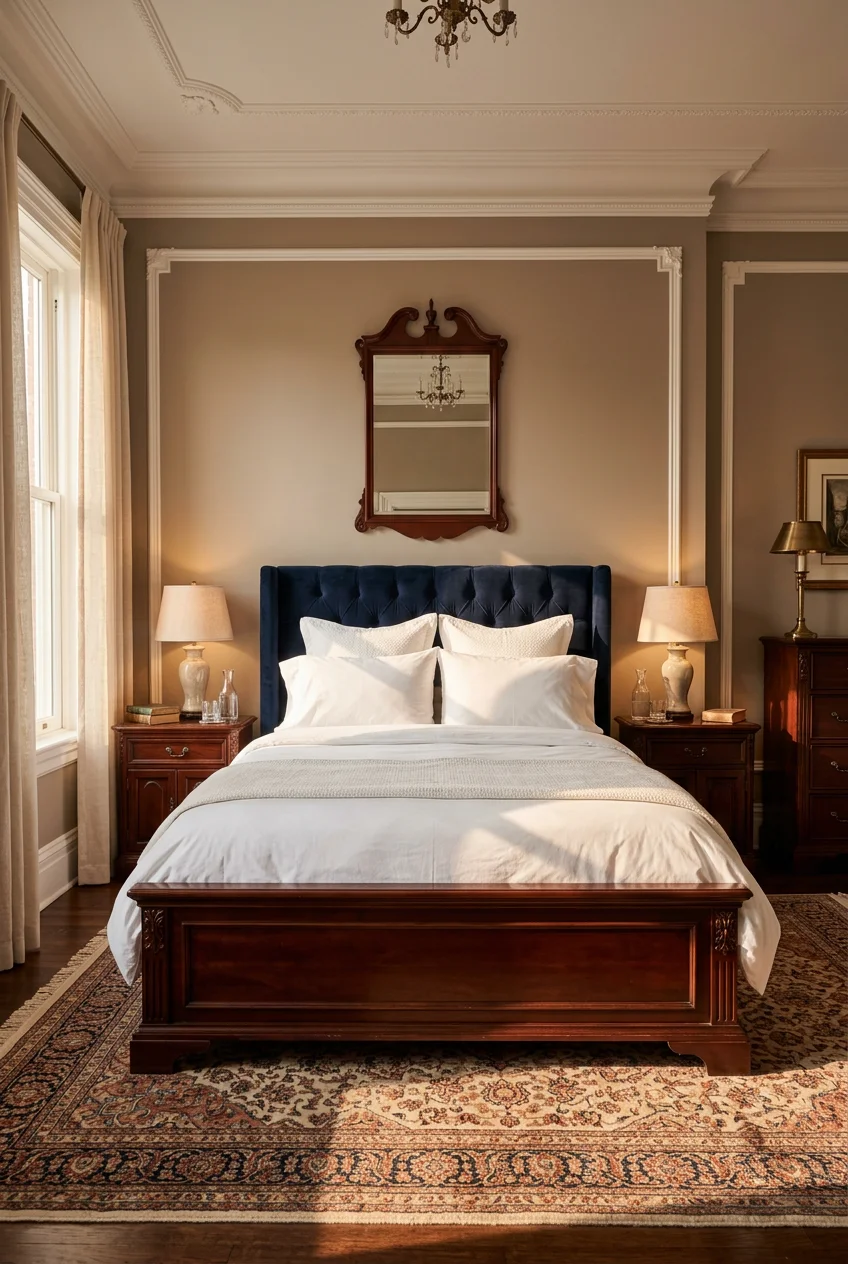
A solid wood bed frame with ornate details is the mandatory focal point for this style. I spent years sleeping on a cheap metal frame before upgrading; the visual weight of real wood completely changes the room’s acoustics and presence. Brands like Ethan Allen offer classic wooden bed frames, like their Continental collection featuring fluted pilasters. Expect to pay around $1,200 to over $4,000 for a quality traditional bed frame in solid teak or mahogany. If you’re buying a four-poster bed, measure your ceiling height first. I brought home a mahogany frame in 2021 that scraped my ceiling fan. You need at least 18 inches of clearance above the posts. Skip the particle board options wrapped in veneer. It peels after a year and looks terrible. Save up for solid wood. A sturdy frame won’t creak when you turn over at night, which is a massive bonus for light sleepers. You can also look for details like brass hardware or carved rosettes on the headboard to ensure the piece feels substantial.
2. Enforce Strict Symmetry with Nightstands and Lamps

Traditional decor thrives on calculated balance. You place matching nightstands in dark wood finishes on either side of your bed, then pair them with identical lamps. For instance, two Pottery Barn Classic Glass Table Lamps cost $159 each. Sitting them on matching Ethan Allen Reagan Night Tables, which run about $850, creates a harmonious and methodical look. I used to mix and match my bedside tables because I thought it looked collected. It just looked messy. Strict symmetry forces the eye to the center of the room. The lamps need to be the exact same height, ideally 24 to 27 inches tall, so the light casts evenly across the mattress. Use 60-watt soft white bulbs from Walmart ($4.99 for a four-pack) to keep the lighting warm. If your room layout forces the bed off-center, you can still maintain symmetry on the immediate wall behind the headboard. Just ensure the distance from the edge of the mattress to the nightstand is identical on both sides. This strict visual discipline calms the brain before sleep.
3. Execute Color-Drenching with Rich, Layered Hues

Traditional bedrooms rely on deep, intentional color palettes like rich reds, greens, golds, and warm neutrals. For 2026, designers use a technique called color-drenching. You paint the walls, trim, and ceilings in one rich hue to build a cohesive, atmospheric retreat. Sherwin-Williams Universal Khaki SW 6150 is a midtone neutral that offers nature-inspired warmth without looking muddy. If you want a bolder approach, Farrow & Ball Radicchio is a velvety red that makes a confident statement at $130 a gallon. I painted my primary bedroom a stark, cool white two years ago. It felt like a hospital waiting room. Warmth is non-negotiable here. Use an eggshell finish on the walls and a satin finish on the trim to create subtle dimension while using the exact same paint color. If you’re nervous about dark colors, start with the khaki. It reflects enough light during the day to keep the room functional, but it absorbs shadows beautifully at night. You won’t regret committing to a deeply saturated hue.

Wooden Love You Bye Sign
A dependable everyday pick — Wooden Love You Bye Sign pulls in 643 ratings at 4.5 stars. Not flashy, just solid.
4. Hang Floor-Length Luxurious Curtains Properly

Curtains dictate the formality of the space. You need floor-length curtains that just touch or hover exactly half an inch above the floor. Standard lengths like 84, 96, or 108 inches are common in retail stores. I bought 84-inch panels once and hung the rod too high. The curtains hovered three inches off the ground and looked like high-water pants. It’s an embarrassing mistake that ruins the proportions of the wall. For a highly formal aesthetic, use puddled curtains that extend 1 to 2 inches onto the floor. Choose heavy fabrics like velvet, silk, or damask. Target sells surprisingly decent heavyweight velvet panels for $35.99 each. Mount your metal curtain rod at least 4 to 6 inches above the top window casing to make your ceiling appear taller. Make sure the rod extends 8 to 10 inches past the window frame on each side. This allows the heavy fabric to stack against the wall when open, rather than blocking your natural light. Thick curtains also provide crucial thermal insulation during winter months.
5. Anchor the Space with a Substantial Area Rug

A plush area rug adds necessary warmth and acoustic dampening. For a queen-sized bed, an 8×10 foot rug is the absolute minimum size. This leaves enough space at the foot of the bed to walk comfortably on the soft surface. For a king-sized bed, a 9×12 foot rug extends 18 to 24 inches beyond the bed’s borders, allowing both nightstands to sit fully on the rug. Avoid rugs that are too small. I put a 5×7 rug under my queen bed, and it chopped the room in half visually. Persian or Oriental rugs with vintage patterns amplify the traditional vibe. You can find large, dense wool rugs at Costco for around $199 during their home events. Ensure you place a 0.25-inch felt rug pad underneath to prevent slipping and add cushion. This pad also protects your hardwood floors from the rough backing of hand-knotted rugs. If you have wall-to-wall carpet, you can still layer a large area rug over it. Just choose a thinner, flat-weave wool rug so you aren’t creating a tripping hazard.
6. Layer Bedding for Authentic Traditional Bedroom Decor

Layering is the mechanical foundation of traditional comfort. You start with a crisp white duvet cover, then add colorful shams, a 14×36 inch lumbar pillow, and a heavy throw at the foot of the bed. Incorporate luxurious quilts and block-printed linens. The patchwork trend features nostalgia-inducing prints that add immediate character. I bought a hand-stitched cotton quilt from Boll & Branch for $250, and the weight of it actually helps me sleep better. Skip the cheap polyester comforters in a bag. They trap heat and pill after three washes. Instead, build your bed layer by layer. Use 100 percent cotton percale sheets as your base. The friction of natural fibers against a heavy quilt creates that specific, tucked-in feeling that defines classic hotel bedding. I always iron my pillowcases with heavy starch. It takes five extra minutes, but resting your face against crisp, cool cotton completely changes the sensory experience of getting into bed. Don’t skip the throw blanket; fold it neatly in thirds at the very edge of the mattress. You might also like: 18 Rustic Living Room Decor for Every Budget

FAEKSUR Framed Abstract Neutral Wall Art for Living Room
FAEKSUR Framed Abstract Neutral Wall Art for Living Room punches above its price — 1 buyers rated it 4.5 stars. I would buy it again.
7. Stop Buying Matching Bedroom Furniture Sets

Purchasing an entire matching bedroom set makes your room feel like a sterile furniture showroom. Instead, you must mix finishes and styles between your bedside tables, dresser, and chest. Mix dark walnut wood with lacquered linen, wrapped leather, or mirrored surfaces. I bought a five-piece matching cherry wood set in 2018. Within a week, I hated it. The room felt heavy, flat, and completely devoid of personality. A curated aesthetic requires friction between different materials. If your bed is heavy mahogany, choose a lighter oak or painted dresser. Pair a leather-wrapped bench with a brass-accented side table. This tension is what makes a room look like it evolved over decades rather than being ordered from a single catalog page on a Tuesday afternoon. If you currently own a matching set, break it up. Move the tall chest of drawers into a guest room or hallway. Replace it with a vintage writing desk or a completely different style of dresser. The visual relief is immediate and necessary. You might also like: 20 Cozy Wall Decor Ideas for Every Budget
8. Ground the Room with Vintage Accents and Heirlooms

Decorating with authentic vintage accents and heirloom trinkets establishes the historical charm required for this style. You need items with actual age, like vintage brass lamps, heavily framed oil artwork, or antique mantel clocks. These pieces provide physical evidence of history. I found a solid brass 1920s alarm clock at a flea market for $45. It doesn’t even work, but sitting on my nightstand, it adds a specific gravity that a plastic digital clock can’t replicate. Don’t overdo it, or your room will smell like a thrift store. Select two or three high-impact vintage pieces. A decorative mirror with an oxidized, classic wood frame leaning against the wall is usually enough to break up the newness of fresh paint and modern mattresses. I also keep a small, tarnished silver tray on my dresser to hold my daily jewelry. The scratches and imperfections on the metal catch the light differently than polished modern pieces. These small historical anchors make the room feel grounded and permanent. You might also like: 15 Cozy Vintage Farmhouse Decor Ideas for a Fresh New Look
9. Build Multiple Layers of Lighting

Relying solely on a single overhead light creates harsh, unflattering shadows and completely ruins the ambiance. You must incorporate multiple light sources on different circuits. Install recessed perimeter lighting for ambient illumination, adjustable brass wall sconces for reading, and heavy table lamps on the nightstands. A vintage crystal chandelier serves as a central statement piece. I tried using just a ceiling fan light for a year. The glare gave me a headache every night. Now, I use 40-watt warm bulbs in my sconces and lamps. You can pick up basic LED warm white bulbs at Kroger for $7.99 a box in their hardware aisle. Turn off the overhead light at 8 PM and rely entirely on the lamps to signal to your brain that it’s time to rest. If you have the budget, install a dimmer switch on your sconces. It costs about $25 for the switch at any hardware store. Being able to drop the light level to a faint glow while reading completely changes the utility of the room.

KHOYIME Large Macrame Wall Hanging Boho Woven Tapestry
If you want something that just works, KHOYIME Large Macrame Wall Hanging Boho Woven Tapestry is a safe bet (994 reviews, 4.5 stars).
10. Master Proper Bed Placement and Height

Your bed is the primary architectural element in the room, making its placement critical. Never place the bed directly in front of a window. I did this in my last apartment, and the draft freezing my neck every winter was miserable. It also ruins the window treatments. Position your bed against a solid, windowless wall. For optimal functionality, the top of your mattress should sit exactly 18 to 20 inches off the floor. This height allows you to sit on the edge with your feet flat on the ground. A common mistake is pushing all your furniture flat against the walls. Pull a small armchair or a reading table 12 inches away from the corner to create depth and shadow behind the furniture. If your room is perfectly square, center the bed on the wall opposite the doorway. This gives you a clear line of sight when entering, which instantly makes the space feel organized and deliberate. Don’t angle the bed in a corner; it wastes square footage and looks incredibly dated.
11. Add a Chaise Lounge or Love Seat

The empty space at the foot of your bed requires a specific piece of furniture to ground it. While wooden blanket boxes work, a velvet chaise lounge or a small love seat offers actual sophistication. This provides functional seating for putting on shoes and acts as a visual barrier between the sleeping area and the rest of the room. I bought a tufted linen love seat from Wayfair for $340. It completely changed how I use the room. I now sit there to read instead of getting back into bed. If you don’t have space for a full chaise, a 48-inch upholstered bench works. Just ensure the fabric contrasts with your duvet cover so the two pieces don’t bleed together visually. I prefer a bench with exposed turned-wood legs. It keeps the floor plan feeling open while still providing the necessary visual stop at the end of the mattress. Keep it clear of laundry to maintain the formal aesthetic.
12. Add Architectural Interest to the Ceiling

Most people completely ignore the ceiling, leaving it as a flat, dead white space. Traditional design requires attention to this fifth wall. Adding detailed polyurethane crown moldings, a decorative ceiling medallion around the light fixture, or even a subtle patterned wallpaper alters an ordinary ceiling. I installed a 16-inch ceiling medallion from Home Depot last month. It cost exactly $28.50 and took 20 minutes with some construction adhesive. It immediately made my cheap light fixture look like a custom installation. If you’re painting the ceiling, use a flat finish to hide drywall imperfections. A high-gloss ceiling only works if your plaster is perfectly smooth, which is almost never the case in houses built after 1950. If you have a tray ceiling, paint the inner recess one shade lighter than your wall color. It draws the eye upward and makes the room feel massive. Even a simple 4-inch crown molding painted in semi-gloss white frames the room perfectly and hides uneven drywall seams.

Vanselia Ceramic Flower Vase Home Decor
Vanselia Ceramic Flower Vase Home Decor – Farmhouse Table Vases Rustic has been one of the most consistently praised picks in this category. 786 reviewers averaged 4.5/5.
13. Practice Texture-Maxxing for Sensory Richness

In 2026, a major design trend is texture-maxxing. This means focusing heavily on sensory exploration beyond just visual colors. You layer heavy knits, brocade over silk, glass beads on lampshades, and thick velvet curtains. A room shouldn’t just look traditional; it needs to feel heavy and tactile. I keep a woven seagrass basket in the corner for extra blankets. I grabbed it from the floral section at Sprouts for $14.99 while buying groceries. The rough texture of the seagrass against the smooth cotton sheets creates necessary contrast. Smooth, flat surfaces read as modern and cold. You need raised embroidery on your throw pillows and thick, looped wool on your rugs to absorb sound and make the space feel intentionally insulated. I also swap out my cotton pillow covers for heavy velvet ones in October. The tactile shift signals the change in seasons. Traditional decor is entirely about how a room feels when you run your hand across the surfaces. Don’t settle for flat, printed fabrics.
14. Introduce Muted Illustrated Statement Rugs

Moving beyond standard Persian patterns, illustrated statement rugs are becoming standard. These rugs feature subtle brush-stroke art, line-drawn elements, or abstract botanical shapes woven into soft textures. To integrate this into a traditional space without ruining the classic aesthetic, you must choose a rug with a highly muted motif and a light beige or cream base color. I ordered a 5×8 wool rug with a faded olive branch illustration for $210. It sits under my reading chair. The key is ensuring the illustration doesn’t use high-contrast colors like black or bright red. The pattern should look like it’s fading into the background. This allows the rug to act as a subtle focal point without fighting your ornate bed frame for attention. I vacuum this rug with the beater bar turned off so I don’t pull the delicate wool fibers. If you spill coffee on a light statement rug, blot it immediately with club soda. Scrubbing will permanently distort the illustrated lines.
15. Create an Analog Space for Better Sleep

Interior designers heavily emphasize creating analog bedrooms. You minimize technology to prioritize your sleep quality and lower your cortisol. This means no televisions mounted on the wall and no glowing charging stations on the nightstand. I used to sleep with my phone charging right next to my head. The constant buzzing ruined my sleep architecture. Now, I use a mechanical twin-bell analog clock I found in the home goods aisle at Whole Foods for $18.99. It ticks quietly and has no blue light. A traditional bedroom should feel like a retreat to a pre-digital era. Hide your necessary cords behind heavy wooden dressers and keep screens in the living room where they belong. If you absolutely must have a phone in the room for emergencies, place it inside a bedside table drawer while it charges. The physical barrier prevents mindless scrolling at 2 AM. Your bedroom is for sleeping, not answering emails. Establish boundaries with your electronics.
Ceramic Vase Set of 3, Vases Home Decor
Ceramic Vase Set of 3 punches above its price — 30 buyers rated it 4.5 stars. I would buy it again.
16. Install Classic Brass Hardware on Dressers

You don’t need to buy entirely new furniture to achieve a classic look. Swapping out cheap factory hardware for unlacquered brass pulls completely changes basic furniture. I bought a plain white six-drawer dresser five years ago. Last month, I replaced the generic silver knobs with heavy brass cup pulls from Rejuvenation that cost $18 each. It feels like a completely different piece of furniture. Unlacquered brass is crucial because it develops a natural patina over time. It reacts to the oils in your hands, darkening in the recesses while staying bright where you touch it. Avoid the fake, spray-painted gold hardware from big box stores. It chips within six months and exposes the cheap zinc underneath. When drilling holes for new pulls, use a template tool. I tried freehanding the measurements on a nightstand once and ended up with crooked handles that drove me crazy until I threw the piece out. Real brass hardware is heavy, cold to the touch, and fixes cheap drawers instantly.
20. Display Real Books on Solid Wood Bookshelves

Traditional rooms require evidence of intellectual life, which means displaying actual hardcover books. Hollow decorative book boxes or color-coded spines look like a staged open house. Stack real, readable books on a solid mahogany or oak bookshelf. I keep a stack of historical biographies on my nightstand and a small two-shelf bookcase under the window. I source old cloth-bound books from library sales for $2 each. Don’t arrange them perfectly. Let some lean, stack a few horizontally, and place a heavy brass bookend on one side. The paper absorbs sound and adds a very specific, dry, vanilla-like scent to the room that synthetic candles can’t replicate. It grounds the space in reality. I avoid paperbacks because the bright, modern spines clash with the muted room palette. Remove the glossy dust jackets from your hardcovers to expose the textured cloth bindings underneath. It’s a free adjustment that immediately makes your book collection look like a curated antique library.
Building a classic room takes patience and a tape measure. I highly recommend starting with the rug and bed frame before you buy any paint or curtains. Save this guide and pin it to your bedroom mood board so you don’t repeat my expensive mistakes.
Frequently Asked Questions
What defines traditional bedroom decor?
Traditional bedroom decor relies on historical design elements, including solid wood furniture, strict symmetry, rich layered color palettes, and heavy textiles like velvet or silk. It prioritizes classic silhouettes over modern minimalism.
Should my traditional bedroom furniture match?
No, buying a matching five-piece bedroom set makes the room look like a sterile catalog. Mix wood finishes, lacquered linen, and vintage pieces to create a curated, collected aesthetic.
What size rug do I need for a traditional queen bed?
You need at least an 8×10 foot area rug for a queen bed. This ensures the rug extends far enough beyond the mattress to provide a soft walking surface and visual balance.
How do I modernize traditional bedroom decor?
Focus on texture-maxxing and color-drenching rather than heavy drapery. Paint the walls, trim, and ceiling the same rich color, and incorporate muted, illustrated statement rugs to soften the historical furniture pieces.
