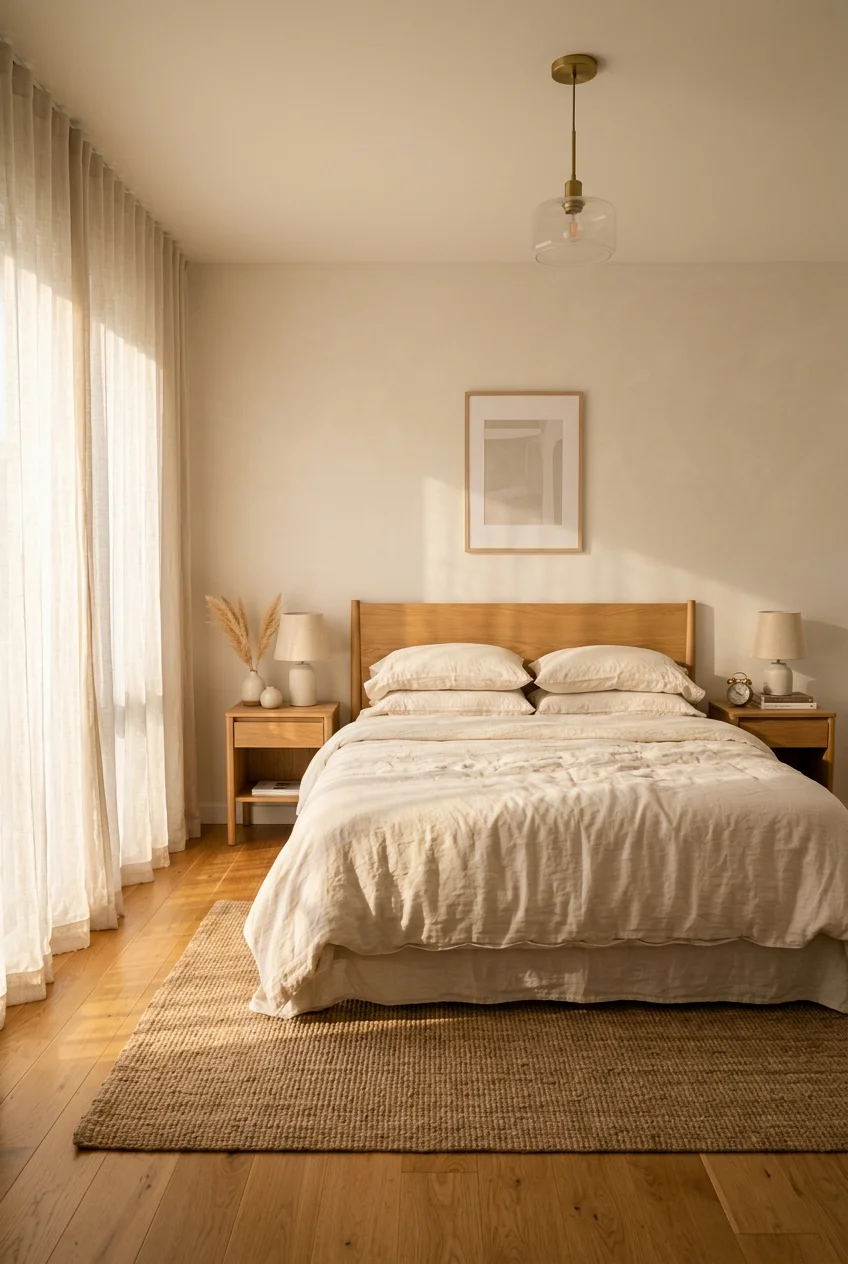
What’s Inside
- Embrace the Cocoon Bedroom Aesthetic with Layered Textures
- Try Color Drenching for a Moody Bedroom Decor Ideas Aesthetic
- Integrate Biophilic Design with Real Plants
- Choose the Right-Sized Area Rug to Anchor Your Space
- Swap to Sculptural and Curved Furniture
- Hang Oversized Artwork for Maximum Impact
- Install Floor-Length Curtains the Right Way
- Practice Middleism for a Balanced Aesthetic
- Incorporate Rechargeable and Smart Lighting
- Choose Floating Nightstands for a Streamlined Look
- Mix and Match Your Bedding Decor Ideas Aesthetic
- Install Wall Paneling for Architectural Interest
- Prioritize Sound Dampening through Textiles
- Select Calming Art for the Wall Opposite the Bed
- Avoid Oversized Beds to Ensure Adequate Walking Space
- Finish with a Signature Scent and Scentscaping
Last November, I sat on my mattress and realized my space felt less like a sanctuary and more like a sterile waiting room. If you’re hunting for bedroom decor ideas, you probably know that feeling of a room that just doesn’t work. I tried forcing a minimalist look for months before figuring it out. It felt cold, echoed when I talked, and gave me zero comfort at the end of a long day. I needed a space that actually felt lived-in. Let’s look at the specific changes that fixed my layout.
1. Embrace the Cocoon Bedroom Aesthetic with Layered Textures

Focus on tactile materials like silk, mohair, and washed linen to build a deeply comforting space. I bought a cheap linen blend from Target last year for $45. It felt exactly like sleeping under a burlap sack. The fabric pilled after two washes and scratched my legs. I switched to a 100 percent stonewashed linen queen duvet cover from Piglet in Bed. The $229 price tag hurts, but the temperature regulation means I don’t wake up sweating in July. Layer a heavy faux fur throw (I found a thick, heavy one for $40 at Costco) at the foot of the bed. Add three velvet toss pillows in contrasting warm tones. The mix of rough linen, soft fur, and smooth velvet creates a literal cocoon. You’re building a space that physically comforts you. When you mix heavy and light textiles, the bed looks inviting instead of flat and institutional. I’ve realized that texture matters just as much as color when you’re trying to make a room feel cozy. If everything is flat cotton, the room feels cold. Trust me on this.
2. Try Color Drenching for a Moody Bedroom Decor Ideas Aesthetic

Color drenching means painting the walls, baseboards, window trim, doors, and ceiling all one single color. I used to think accent walls were the safe bet. I tried a dark blue accent wall in my guest room and it looked like a massive mistake. It chopped the room in half visually. For a cohesive look, use a rich, earthy tone. I highly recommend Benjamin Moore’s Silhouette AF-655. It’s a deep, luxurious burnt umber that costs about $65 a gallon. If that’s too dark for your taste, Sherwin-Williams’ Universal Khaki is a fantastic warm neutral alternative. Painting the ceiling the exact same color eliminates the harsh white line at the top of the room. This visual trick makes an 8-foot ceiling feel significantly taller. It requires about three gallons for a standard 10×12 room, so budget around $200 for high-quality paint. The result is a room that wraps around you. I’ve found that skipping the stark white trim makes the space feel intentional and expensive. You won’t regret painting the baseboards to match.
3. Integrate Biophilic Design with Real Plants

Biophilic design connects your indoor space directly with nature. Skip the fake plastic vines. I bought a plastic fern from Walmart once. It just collected dust, looked incredibly sad, and made the room feel cheap. Instead, go for a real Fiddle-Leaf Fig or a Monstera plant. I found a very healthy 3-foot Monstera at Sprouts last Tuesday for exactly $14.99. Place it in an empty corner near a window to purify the air. Pair the living greenery with natural materials like a solid reclaimed wood bed frame. The organic grain of the wood mixed with the green leaves brings actual life into a stagnant room. If you’re terrible with plants, a Snake Plant requires watering maybe once a month. It still gives you that organic, natural texture without the stress of keeping a delicate fern alive. Real nature makes a room breathe. I’ve noticed my air quality feels noticeably better since I added real soil and leaves to my sleeping space. It’s a simple fix that adds vibrant color without needing paint.

UTTCMK Bookshelf Decor Thinker Statue
Honestly, UTTCMK Bookshelf Decor Thinker Statue – Abstract Art Reading Thinker S surprised me — sturdier than it looks in the photos, and over 809 buyers gave it 4.5 stars.
4. Choose the Right-Sized Area Rug to Anchor Your Space

A postage-stamp rug floating in the middle of the floor is a massive pet peeve of mine. I lived with a tiny 4×6 rug under my queen bed for two years. My feet hit cold hardwood every single morning, which completely ruined the cozy vibe. You can’t just throw a tiny rug under a big bed and expect it to look right. For a standard queen-sized bed (which is exactly 60 inches wide by 80 inches long), you need an 8′ x 10′ or 9′ x 12′ rug. This specific sizing allows the rug to extend 18 to 24 inches beyond the sides and the foot of the bed. You actually get to step on a soft surface when you wake up. I picked up a thick wool 8×10 rug at Costco last month for $199. If your room is very cramped, a 6′ x 9′ rug can work. You’ll only get about 24 inches of coverage around the bottom half of the bed, but it’s better than nothing. Proper rug sizing anchors the furniture so it doesn’t look like it’s floating away. No exaggeration.
5. Swap to Sculptural and Curved Furniture

Angular, sharp-edged furniture looks incredibly harsh in a room meant for sleeping. I still carry the dark bruises on my shins to prove that a sharp wooden platform bed is a literal hazard in the dark. Curved and sculptural bed frames are replacing those hard lines right now. Look for beds with rounded, upholstered headboards. The soft arches visually soften the entire room. I recently tested a boucle upholstered frame with a curved headboard (around $450 from Wayfair). The textured fabric and the rounded corners make the whole room feel less rigid and much more inviting. It’s a subtle shift, but removing hard 90-degree angles from your line of sight tells your brain it’s time to relax. Soft lines mimic the natural shapes we find comforting, rather than the sharp corners of an office building. I’ve noticed I sleep better just by removing those visual threats. When your eye moves around the room, it shouldn’t hit harsh stops. A curved nightstand or a rounded chair can do the same trick if you can’t replace your bed. You might also like: 20 Beautiful Home Decor Ideas for Any Style
6. Hang Oversized Artwork for Maximum Impact

Gallery walls are exhausting to plan and even harder to keep straight. I spent four hours hanging a 12-piece gallery wall above my bed, only to realize it looked cluttered and chaotic. A heavy frame actually fell on my pillow one night because I used cheap adhesive hooks. Instead, use a single oversized piece of artwork above the bed. The rule of thumb here is strict. The canvas should be 60 to 80 percent of the width of your bed or headboard. For a 60-inch queen bed, you want a piece that’s 36 to 48 inches wide. Hang it exactly 6 to 12 inches above the top of the headboard. I found a massive 40-inch canvas at Kroger’s home goods section for $55. It features an abstract landscape in muted greens. One large piece provides a clean, intentional focal point. It anchors the wall without overwhelming your eyes with dozens of tiny frames. Plus, you only need to put one nail in the wall. It makes dusting significantly easier, too. You might also like: 15 Clever DIY Cozy Home Decor That Make a Real Difference

Farmhouse White Fake Decorative Books for Home Office Decor
A dependable everyday pick — Farmhouse White Fake Decorative Books for Home Office Decor – Religion pulls in 10 ratings at 4.5 stars. Not flashy, just solid.
7. Install Floor-Length Curtains the Right Way

Short curtains are the capri pants of home decor. They cut the room off at the knees and look unfinished. I bought 84-inch curtains for my 9-foot ceilings and they dangled awkwardly three inches above the floor. To fix this, you need curtains that just barely touch or hover half an inch above the floor. Mount your curtain rod 4 to 6 inches above the window trim. If your space has standard 8-foot ceilings, push the rod almost to the ceiling line. Then, extend the rod 3 to 6 inches past each side of the window. This allows the fabric to stack against the wall, not the glass. It makes your window look twice as wide and lets in way more natural light. Heavy linen panels cost about $35 each, but the architectural height they add is worth every single penny. I’ve found that cheap, sheer curtains make a room look like a dorm. Investing in thick, textured fabric that hits the floor properly fixes the proportions of the entire space. You might also like: 20 Cozy Aesthetic Cozy Home Decor That Make a Real Difference
8. Practice Middleism for a Balanced Aesthetic

Middleism is the exact midpoint between stark minimalism and chaotic maximalism. It prioritizes high-quality craftsmanship over sheer volume. I used to buy handfuls of cheap knick-knacks from the Target dollar section. They ended up in a donation bin six months later because they added visual noise, not value. Now, I focus on a few meaningful pieces. A handmade ceramic vase ($45 from a local potter) sitting on a solid oak dresser is enough. You don’t need to fill every empty surface. Leave some negative space on your nightstand. A space that is calm but clearly lived-in feels much more welcoming than a sterile showroom or a cluttered thrift shop. Quality materials speak for themselves. You don’t need fifty items on a shelf when three well-made objects do the job perfectly. I’d rather have an empty wall than a cluttered one. Editing your possessions down to the things you actually use makes the room function better. You won’t spend your Saturday mornings dusting things you don’t even like looking at.
9. Incorporate Rechargeable and Smart Lighting

Nothing ruins a calm vibe faster than a tangle of black electrical cords snaking down your wall. I hate dealing with extension cords behind a heavy bed frame. Rechargeable, portable bedside lamps are the practical solution. Brands like Pooky sell cordless brass sconces for around $150. You mount the hardware directly to the drywall. There’s no hardwiring required. You just pop the bulb out to charge it via USB once a week. Also, never rely on a single ceiling fixture right above your bed. It creates a harsh, interrogating glare. I use dimmable smart bulbs (like Philips Hue, $49 for a two-pack) in my bedside lamps. I set them to a warm 2700K color temperature at 20 percent brightness before bed. It signals to your body that the day is actually over. I’ve found that layering light from the corners of the room, rather than blasting it from the center of the ceiling, makes the space feel like a high-end hotel. You control the mood entirely through the wattage.

GODONLIF Candle Warmer Lamp with Timer Dimmable
GODONLIF Candle Warmer Lamp with Timer Dimmable punches above its price — 77 buyers rated it 4.5 stars. I would buy it again.
10. Choose Floating Nightstands for a Streamlined Look

Bulky, heavy nightstands eat up valuable floor space and make small rooms feel claustrophobic. I swapped my heavy wooden bedside tables for floating nightstands and the difference is massive. I highly recommend the Lenia Floating Nightstand from Article. It costs $249 and measures exactly 6 inches high, 19.75 inches wide, and 15.25 inches deep. It has a single sleek drawer for my lip balm and earplugs, keeping the surface completely clear. When you mount these, make sure the top surface aligns exactly with the top of your mattress, or sits about an inch below it. This makes reaching for your water glass in the dark much easier and prevents you from knocking things over. Plus, you can easily run a vacuum underneath them without moving heavy furniture. It keeps the dust bunnies away without breaking your back. I’ve noticed my bedroom feels twice as wide simply because I can see the baseboards running all the way to the corners. Visual floor space matters just as much as square footage.
11. Mix and Match Your Bedding Decor Ideas Aesthetic

Buying a “bed in a bag” where everything matches perfectly is a trap. I bought a 10-piece matching gray set in my twenties and it looked incredibly flat and institutional. Jessica Hanley of Piglet in Bed notes that mixing colors and patterns is the practical way forward. Start with solid-colored fitted and flat sheets. I usually go with an olive green or a deep rust. Then, add a subtly patterned duvet cover, like a thin ticking stripe or a muted gingham. Finish it with a heavily textured wool throw blanket at the foot of the bed. As long as you stick to a cohesive warm color palette, the mixed patterns won’t look chaotic. They just look layered and expensive. It gives the bed dimension instead of looking like a cheap hotel room. You’re aiming for a collected look, not a catalog page. I’ve found that washing different textures together eventually softens everything up, making the bed feel custom. Don’t be afraid to pair a floral pillowcase with a striped duvet.
12. Install Wall Paneling for Architectural Interest

Plain drywall can be incredibly boring. Adding wall paneling behind your bed creates an instant, built-in headboard effect. I spent a weekend installing vertical acoustic wood slats on my bedroom wall. You can buy 94-inch tall wood slat panels from hardware stores for about $120 per panel. You just apply construction adhesive and nail them right into the studs. The vertical lines draw the eye up, making the ceiling feel significantly higher. Plus, the acoustic felt backing behind the wood slats actually absorbs echoes in the room. It gives the space a high-end, custom architectural feel without requiring a contractor or a massive renovation budget. It’s a weekend project that completely changes the footprint of the room. I’ve seen standard drywall turn into a textured feature wall in just a few hours. The wood tones add warmth that paint simply can’t replicate. If you’re renting, you can even mount the panels to a large piece of plywood and lean it against the wall for a temporary fix.

Lwenki Key Holder for Wall
If you want something that just works, Lwenki Key Holder for Wall is a safe bet (86 reviews, 4.5 stars).
13. Prioritize Sound Dampening through Textiles

Most people completely ignore how a room sounds. I used to live in an apartment facing a busy street. The garbage trucks at 6 AM drove me insane. Hardwoods and bare walls bounce sound waves around, making every noise sharper and louder. To create a quiet cocoon, you need thick textiles to absorb the sound. Heavy velvet blackout curtains (I found a great pair for $60) block light and muffle street noise. A thick wool rug with a half-inch felt rug pad underneath ($45 for the pad) stops footsteps from echoing. Even adding an upholstered headboard instead of a metal one helps dampen the acoustics. A quiet room is just as important as a pretty one. If you can hear every car drive by, you aren’t going to sleep well. I’ve noticed that simply adding more fabric to the room lowers the decibel level noticeably. You don’t need professional soundproofing foam. Just layer your window treatments and put a thick rug pad under your area rug. I learned that the hard way.
14. Select Calming Art for the Wall Opposite the Bed

We spend so much time decorating the wall behind the bed, but you never actually see it when you’re lying down. The wall opposite your bed is your actual view when you wake up. I used to have a bright, chaotic abstract painting across from my bed. It was visually loud and annoyed me every morning. I swapped it for a large, muted photograph of a foggy forest I printed at a local shop for $35. Choose an image that inspires calm. Avoid anything with heavy text, aggressive colors, or complicated patterns. You want your eyes to rest on something peaceful right before you go to sleep and right when you wake up. It sets the tone for your entire morning routine. I’d highly suggest finding a local artist who shoots landscape photography. A simple horizon line helps your brain decompress. I’ve tried putting a television on that wall, but the black plastic rectangle just ruins the aesthetic. A beautiful piece of art serves you much better.
15. Avoid Oversized Beds to Ensure Adequate Walking Space

Cramming a king-sized bed into a 10×10 foot room is the most common layout mistake I see. I tried this in my last house. I had to turn sideways and shuffle against the wall just to get to my closet. It’s miserable. You need a minimum of 24 to 36 inches of clear walking space on both sides and at the foot of the bed. If your space is a standard 10×10 room, a queen-size bed (60 inches wide) is the maximum size you should buy. This leaves you with about 30 inches on each side for nightstands and walking paths. Breathing room around your furniture is what makes a space feel luxurious, not the physical size of the mattress. Give yourself room to actually walk. A smaller bed in a spacious room always feels more luxurious than a massive bed crammed against a wall. I’ve bumped my hips on dresser corners enough times to know that clearance matters. Prioritize your walking path over mattress width.

Hanobe Candle Plate Holder Tray: Round Wood Decorative
A dependable everyday pick — Hanobe Candle Plate Holder Tray: Round Wood Decorative Candle Plate – pulls in 27 ratings at 4.5 stars. Not flashy, just solid.
16. Finish with a Signature Scent and Scentscaping

A room isn’t finished until it smells right. I used to burn cheap, sugary vanilla candles that gave me headaches and left black soot on the walls. Now, I focus on specific, natural scentscaping to signal to my brain that it’s time to wind down. I use a ceramic ultrasonic diffuser on my floating nightstand. I buy pure lavender and cedarwood essential oils from Whole Foods for $7.99 per half-ounce bottle. Three drops of lavender and two drops of cedarwood create a woody, calming scent that isn’t overpowering. If you prefer candles, the Trader Joe’s tin candles are surprisingly good for $3.99. Their Honeycrisp Apple scent in the fall is subtle and burns cleanly. Scent is the final layer that makes the room feel completely yours. I’ve found that running the diffuser for just twenty minutes before I get under the covers completely changes my mood. It’s a tiny detail, but it bridges the gap between a room that just looks nice and a room that actually feels like home.
Taking the time to adjust these details completely shifted how I use my space. I’m no longer avoiding my room during the day. If you’re tackling your own layout, pick just two or three of these changes to start. Don’t try to buy everything at once. Save this list, pin the ideas that actually fit your floor plan, and take it slow. You’ll build a room you actually want to sleep in.
Frequently Asked Questions
What size rug do I need for a queen bed?
For a standard queen bed, you need an 8×10 or 9×12 foot rug. This allows the material to extend 18 to 24 inches beyond the sides and foot of the bed.
How high should I hang artwork above my bed?
Hang your oversized artwork exactly 6 to 12 inches above the top of your headboard. The piece should be 60 to 80 percent of the width of the bed.
What is color drenching in a bedroom?
Color drenching involves painting your walls, trim, doors, and ceiling all the same color. It creates a cohesive, moody environment and makes 8-foot ceilings feel taller.
How can I make a small bedroom feel bigger?
Use floating nightstands to clear floor space, hang floor-length curtains 4 to 6 inches above the window trim, and ensure you have 24 to 36 inches of walking space around the bed.
