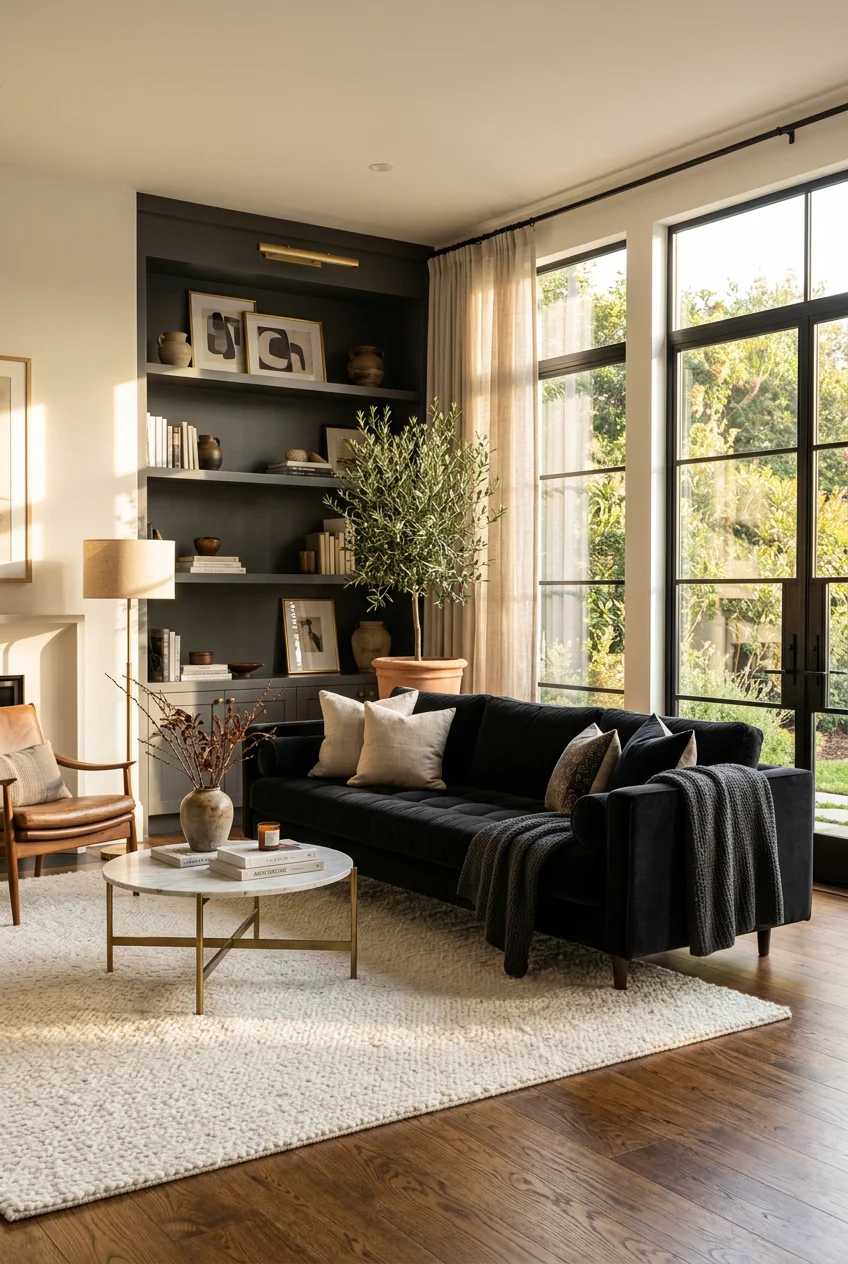
What’s Inside
- Balance with Light, Warm Neutrals on Walls
- Layer Diverse Textures with Pillows
- Incorporate Warm Wood Elements
- Implement Strategic Layered Lighting
- Accent with 2026 Trending Jewel Tones
- Anchor the Room with a Large, Light-Colored Area Rug
- Embrace Biophilic Design with Lush Indoor Plants
- Incorporate Metallic Accents for a Touch of Glamour
- Select Complementary Accent Chairs
- Choose Light and Airy Curtains
- Pair with a Thoughtfully Chosen Coffee Table
- Curate Wall Art to Add Visual Interest
- Embrace Sustainable and Natural Materials
- Focus on a Less but Better Mindset
- Master Monochromatic with Texture
- Position Furniture to Maximize Walkways
- Use Large Floor Mirrors to Double the Light
- Style with a High-Contrast Throw Blanket
- Keep the Media Console Low Profile
I bought a massive charcoal velvet sectional last Tuesday, shoved it against my white apartment wall, and immediately felt like I was staring into a black hole. Figuring out how to balance that dark gravity well took months of expensive trial and error, but it forced me to compile these exact black sofa living room decor ideas. If you’re struggling to make your dark furniture look intentional rather than accidental, this breakdown covers the precise measurements, paint codes, and styling rules that actually work. Trust me on this.
1. Balance with Light, Warm Neutrals on Walls

Let’s start with the paint. Most people default to stark white walls behind dark furniture. I did this in my last apartment and it looked like a sterile waiting room. The contrast is too harsh. You need a warm, light backdrop to act as a grounding anchor. I recommend HGTV Home by Sherwin-Williams’ 2026 Color of the Year, “Universal Khaki,” or Behr’s “Hidden Gem” (a smoky jade). I bought a $5.98 sample pint of Hidden Gem at Home Depot last month to test behind my own sofa. The smoky undertones soften the heavy visual weight of the black upholstery. If you prefer beige, Universal Khaki prevents the room from feeling like a cave while still bouncing natural light around the space. Paint a 3×3 foot test patch before committing. The black fabric absorbs surrounding light, which changes how paint swatches read in the room. Give it 24 hours to cure so you can see it in morning and evening light.
2. Layer Diverse Textures with Pillows

A black sofa looks flat and cheap if you don’t break up the surface area. You need 2-3 different textures to create visual depth. Right now, bouclé, washed linen, and velvet are highly functional choices that hold up to daily use. I bought the “Charlotte Velvet Pillow” and paired it with a “Lyla Decorative Pillow” in embroidered linen from Living Cozy. The covers run about $30 to $80 each. I learned the hard way that using only flat cotton covers makes the couch look like a dorm futon. No exaggeration. The mix of the heavy velvet and the lighter, textured linen catches the light differently, which stops the sofa from looking like a solid black void. Skip the cheap polyester inserts. They flatten out after a week. Buy 20×20 inch down-alternative inserts for 18×18 inch covers to get a dense, supportive feel. I usually grab the two-packs at Target for $22. It’s a small detail that fixes sagging cushions.
3. Incorporate Warm Wood Elements

Black furniture needs organic warmth to stop the room from feeling industrial. You want woods with a natural patina, like aged oak, walnut, or teak. A light oak coffee table or floating walnut shelving softens the boldness of the upholstery. I hung a “Creative Arts n Frames Wooden Framed Wall Mirror” above my side table. I paid $89 for it on Amazon. The warm wood frame directly contrasts with the dark fabric nearby. When I originally tried matching my side tables to the sofa using black MDF, the whole corner looked heavy and depressing. Wood grain introduces a natural irregularity that breaks up the solid blocks of color. If you’re working with a tight budget, look for raw pine crates at Walmart (around $12 each), stain them with a $7 can of Minwax Provincial wood stain, and stack them for quick, warm-toned shelving next to the armrest.

Jexine 4 Pcs Hanging Planters with Artificial Eucalyptus
Jexine 4 Pcs Hanging Planters with Artificial Eucalyptus Metal Hanging punches above its price — 12 buyers rated it 4.5 stars. I would buy it again.
4. Implement Strategic Layered Lighting

Black fabric literally absorbs light. If you rely on a single ceiling bulb, your seating area will turn into a shadowy pit. Layered lighting is mandatory for these black sofa living room decor ideas. You need ambient, task, and accent lighting. For ambient light, I installed the “BrightLyt Deer Horns Hanging Lights” (I paid $185). Then I added a brass floor lamp from Target ($60) for task lighting over the reading corner. Finally, I ran a 16-foot Philips Hue LED strip ($80) behind the media console. This three-point approach distributes brightness evenly. I tried skipping the accent lighting for a year, and the room always felt dim at night, no matter how bright the main overhead fixture was. Put your overhead lights on a dimmer switch. You want the ability to lower the ceiling glare while keeping the floor and table lamps bright.
5. Accent with 2026 Trending Jewel Tones

Black is a neutral, which means it handles highly saturated colors better than gray or beige does. Muddy pastels look dirty next to black. You need rich jewel tones or deep earthy hues to hold their own against the dark upholstery. Teal, burgundy, oxblood, and damson are highly effective. I use a “Petra Marsala Throw Pillow” from Living Cozy. It cost me $55. The deep earthy red grounds the space without looking like a primary color wheel. I previously bought some pale pink cushions from HomeGoods, and they looked completely washed out next to the heavy black fabric. If you’re nervous about color, start small. Buy a $15 ceramic vase in Patina Blue from Kroger’s home section and set it on your coffee table. It provides just enough saturation to draw the eye away from the bulky furniture.
6. Anchor the Room with a Large, Light-Colored Area Rug

A dark rug under a dark couch makes the room bottom-heavy. I made this mistake in 2019. I put a charcoal 8×10 rug under my black sectional, and the entire floor disappeared. You need a large area rug in white, cream, soft gray, or natural tan to visually lift the space. A chunky jute rug is highly practical here. It offers an earthy, handmade texture that hides dirt while providing massive contrast against the dark seating. I bought an 8×10 natural jute rug from RugsUSA for $140. Ensure the rug is large enough for at least the front legs of the sofa and accent chairs to rest on it. If the rug just floats in the middle of the room, the scale will look entirely wrong. If you have pets and worry about light rugs, buy a washable Ruggable in a light gray geometric pattern. The 8×10 size runs about $399.

Ceramic Vase Set of 3, Vases Home Decor
Ceramic Vase Set of 3 has been one of the most consistently praised picks in this category. 30 reviewers averaged 4.5/5.
7. Embrace Biophilic Design with Lush Indoor Plants

Plants soften the harsh, geometric lines of a dark couch. You need large, structural plants with big, waxy leaves. Trailing greenery on a high shelf also works well. I keep a 5-foot Fiddle Leaf Fig right next to my left armrest. I bought it at Sprouts for $45. The bright green leaves pop aggressively against the black fabric. I put it in a large recycled-glass planter I found at a local nursery for $30. If you kill real plants, don’t buy cheap plastic fakes. They collect dust and look terrible up close. Instead, buy dried pampas grass or preserved eucalyptus branches. I get bundles of eucalyptus at Trader Joe’s for $3.99. They dry out perfectly in a vase and add organic texture without requiring a watering schedule. The natural elements break up the heavy, synthetic feel of modern upholstery. You might also like: 20 Cozy Apartment Decor You Need to See
8. Incorporate Metallic Accents for a Touch of Glamour

Metallic finishes reflect light, which is exactly what you need around light-absorbing furniture. Gold, brass, silver, or chrome hardware cuts through the visual weight of the room. I swapped out the cheap plastic legs on my sofa for 6-inch brass tapered legs I found on Amazon for $24. It lifted the piece off the floor and added a subtle, luminous contrast. You can also use brass lamp bases, a minimalist golden chandelier, or silver picture frames. I keep a hammered copper tray on my coffee table to hold remotes. I picked it up at Costco last winter for $19.99. Don’t mix more than two metal finishes in one room, or it starts to look cluttered. I stick to brushed brass and matte black. The brass provides the necessary warmth and reflection, while the matte black ties back to the main seating. You might also like: 16 Dopamine Decor Living Room Worth Trying
9. Select Complementary Accent Chairs

Matching your accent chairs to your sofa is a mistake. It creates a heavy, monolithic look that swallows the room. You need contrasting tones or materials to balance the space. I recommend soft neutral shades like beige, or muted jewel tones. The “Naples Shell Back Accent Chair in Lapis Blue Boucle Fabric” from Living Spaces costs $195. It offers both color and texture contrast against smooth black fabric. If you absolutely want a monochromatic layout, you must vary the materials. The “Tenley Black Leather Accent Chair” from Bob’s Discount Furniture runs $279.99. Pairing a black leather chair with a black velvet couch works because the leather reflects light while the velvet absorbs it. I tried using two black linen chairs with my black linen couch once. The room looked like a waiting area for a funeral home. Contrast is non-negotiable. You might also like: 15 TV Stand Decor Living Room for Every Budget

Bookshelf Decor, Coffee Table Decor
A dependable everyday pick — Bookshelf Decor pulls in 76 ratings at 4.5 stars. Not flashy, just solid.
10. Choose Light and Airy Curtains

Heavy blackout drapes paired with dark furniture will shrink your room instantly. You need to maximize natural light to make these black sofa living room decor ideas function properly. Opt for sheer white or light-colored linen curtains. They allow sunlight to filter through while creating a soft, vertical contrast behind the furniture. I use the “Exclusive Fabrics & Furnishings Essential Faux Linen” panels in off-white. I buy them at Home Depot for $35 per panel. They look like expensive Belgian linen but can be thrown in the washing machine. Mount your curtain rods at least 4 to 6 inches above the window frame, and let the fabric kiss the floor. This draws the eye upward, making the ceilings feel higher and counteracting the heavy, low profile of the couch. I hang mine on a simple $15 matte black tension rod from Target to tie the hardware to the seating.
11. Pair with a Thoughtfully Chosen Coffee Table

Never put a black coffee table in front of a black couch. I did this in my twenties, and it created a massive dark void in the center of my apartment. You need materials that break up the darkness. A marble surface adds a luxurious touch, light wood finishes provide warmth, and glass or lucite creates an airy, transparent feel. I currently use a 36-inch round glass coffee table with a light oak base. I bought it at Wayfair for $180. The glass top allows you to see the light-colored rug underneath, which keeps the floor space feeling open and uninterrupted. If you have kids and glass isn’t practical, get a padded storage ottoman in a light gray or tan fabric. Target sells a 30-inch round cream sherpa ottoman for $90. It gives you hidden storage and acts as a soft, contrasting centerpiece.
12. Curate Wall Art to Add Visual Interest

A large dark couch demands appropriately scaled wall decor above it. If you hang one tiny 8×10 frame over a 90-inch sectional, the proportions will look completely wrong. You need large neutral art pieces or a structured gallery wall. A black sofa is an excellent backdrop for eclectic color schemes because it grounds the space. I built a gallery wall using six 16×20 inch black frames from Walmart ($14 each). I filled them with high-contrast black and white architectural photography. The matching frames tie into the couch, while the white matting brightens the wall. If you want a simpler approach, buy a massive 40×60 inch canvas. I stretch my own canvas over wood stretcher bars and staple raw drop cloth over it for a minimalist, textured look. A 6×9 foot canvas drop cloth at Home Depot costs $12, making it a highly cost-effective way to fill a large wall.

Modern Clear Coaster Set of 5- Glass Coasters for Drinks
If you want something that just works, Modern Clear Coaster Set of 5- Glass Coasters for Drinks Crystal Coast is a safe bet (431 reviews, 4.5 stars).
13. Embrace Sustainable and Natural Materials

Synthetic fabrics and dark dyes can make a room feel artificial. Introducing natural, sustainable materials grounds the space and adds much-needed texture. Look for items made from bamboo, rattan, jute, or organic cotton. I use a large rattan basket from Hantique’s Rattan Collection to hold my spare blankets. It cost me $65. The woven texture and honey-blonde color sit next to the armrest, providing a warm contrast to the dark upholstery. It serves as stylish storage while acting as sculptural decor. I previously used a cheap plastic storage bin, and it made the whole corner look like a utility closet. Natural materials show slight imperfections, which is exactly what you want when dealing with the rigid, uniform look of a modern couch. Even a $15 woven seagrass tray from Target on your coffee table will help bridge the gap between heavy furniture and organic design.
14. Focus on a Less but Better Mindset

Clutter looks worse around dark furniture because the contrast makes every stray item stand out. You need to adopt a crafted minimalism approach. Instead of buying fifteen cheap knick-knacks, invest in three high-quality items that are well-made and durable. I stopped buying cheap seasonal decor and bought a handmade olive wood fruit basket from Hantique. It cost $55. I keep it on the console table behind the couch. The wood grain is unique, and it feels heavy and intentional. When you limit your decor, the items you do display carry more visual weight. I used to crowd my side tables with stacks of unread books, half-burned candles, and mail. It made the seating area feel chaotic. Now, I keep exactly one brass lamp and one stone coaster on the side table. This discipline forces the room to look styled rather than messy.
15. Master Monochromatic with Texture

You don’t have to avoid dark colors entirely. A monochromatic scheme with black and gray can look incredibly sophisticated if you introduce significant textural variety. If everything is flat cotton, it looks gloomy. But if you pair a black velvet couch with a charcoal gray wool rug and throw pillows in dark gray linen and black faux fur, the room feels unified and calming. I bought a 24×24 inch black faux rabbit fur pillow from Amazon for $22. The texture catches the light so dynamically that it reads as a completely different color than the velvet cushions behind it. The trick to monochromatic styling is subtle shade differences. Don’t try to color-match everything perfectly. Let the grays shift from slate to charcoal. I painted my media console in Sherwin-Williams Peppercorn (a dark gray), which sits beautifully across from the black seating without turning the room into a cave.

Vanselia Ceramic Flower Vase Home Decor
Honestly, Vanselia Ceramic Flower Vase Home Decor – Farmhouse Table Vases Rustic surprised me — sturdier than it looks in the photos, and over 786 buyers gave it 4.5 stars.
16. Position Furniture to Maximize Walkways

Dark furniture visually shrinks the space it occupies. If you cram a massive dark sectional into a tight corner, the entire room will feel claustrophobic. You need to leave generous walkways around the piece. I maintain a minimum of 36 inches of clearance between the back of my couch and the dining table behind it. I learned this after I originally pushed my sofa just 18 inches away from my kitchen island. I was constantly bumping my hips on the counter while trying to sit down. Pull the furniture at least 4 inches away from the walls. Floating the couch slightly creates a shadow line that makes the room feel wider. If your space is tiny, don’t buy an oversized piece. I bought a 72-inch apartment-sized sofa for my first studio instead of a standard 84-inch one. It cost $450 at IKEA and left enough breathing room to prevent the space from feeling choked.
17. Use Large Floor Mirrors to Double the Light

Since we established that black fabric eats light, you need to bounce as much natural sunlight around the room as possible. A strategically placed floor mirror is the easiest way to do this. You want to place the mirror adjacent to, or directly across from, your largest window. I bought a 65×22 inch arched floor mirror from Walmart for $65. I leaned it against the wall perpendicular to my balcony sliding door. It catches the afternoon sun and reflects it directly onto the dark upholstery, highlighting the texture of the fabric. Don’t place a mirror where it only reflects a blank wall or a messy hallway. The reflection becomes part of your room’s visual footprint. I made the mistake of angling a mirror toward my messy kitchen sink once. I essentially doubled my dirty dishes. Angle it to reflect your plants, your art, or the outdoors.
18. Style with a High-Contrast Throw Blanket

The back and arms of a dark couch offer a lot of empty, heavy square footage. A high-contrast throw blanket breaks up this solid block of color instantly. I use a cream-colored, chunky knit throw blanket I found at Target for $35. I don’t fold it perfectly over the armrest. A rigid fold looks too stiff. Instead, I pinch it by the center, drag it over the back corner of the cushions, and let it drape naturally. This casual styling adds movement to the rigid lines of the furniture. I wash the blanket every two weeks because the light color shows dog hair and dust immediately. That’s the tradeoff for high contrast. If you hate washing blankets, buy a medium-gray heathered wool throw. It hides dirt better while still providing enough visual separation from the black fabric. I keep a $40 Pendleton wool camp blanket folded in my rattan basket for this exact reason.
19. Keep the Media Console Low Profile

When you have a heavy, dark couch on one side of the room, you can’t put a massive, tall entertainment center on the opposite wall. The room will feel like it’s closing in on you. You need a low-profile media console to keep the sightlines open. I use a slatted walnut TV stand that sits only 18 inches off the floor. I bought it on Wayfair for $210. Keeping the furniture low allows the wall space above it to breathe. I mounted my 55-inch TV directly to the wall, leaving a 6-inch gap between the bottom of the screen and the top of the console. This separation makes the wall look taller. I used to have a 6-foot-tall black bookshelf next to my TV. Combined with the dark seating, the room felt like a tunnel. I sold the bookshelf on Facebook Marketplace for $40 and instantly felt the room open up.
Decorating around dark furniture doesn’t have to be a frustrating battle against shadows. I’ve spent years moving rugs, returning paint samples, and swapping out pillows to figure out what actually works. If you start with a light rug, add warm wood tones, and layer your lighting, that heavy piece of furniture will finally look like a deliberate design choice. I recommend tackling the lighting first. It makes the biggest immediate difference. Pin this list of black sofa living room decor ideas to your home mood board so you have the exact measurements and paint colors ready for your next weekend project.
Frequently Asked Questions
What color walls go best with a black sofa?
Warm, light neutrals work best to balance the dark upholstery. Stark white creates too much harsh contrast. I use colors like Sherwin-Williams’ Universal Khaki or Behr’s Hidden Gem to provide a soft, grounded backdrop that bounces natural light around the room.
How do you brighten a room with a black couch?
You need layered lighting and high-contrast textiles. I use a bright, light-colored jute area rug under the sofa to visually lift the floor space. Adding brass or gold metallic accents and hanging a large floor mirror near a window also helps reflect sunlight.
What color accent chairs pair well with black sofas?
Avoid matching black chairs unless you use a contrasting material like leather against velvet. Soft neutral shades like beige, cream, or muted jewel tones like lapis blue provide necessary visual separation. This prevents the seating area from looking like a heavy, monolithic block.
Are black sofas a good idea for small living rooms?
They can work if you scale the furniture properly and leave enough walkway clearance. I recommend an apartment-sized 72-inch sofa rather than a bulky 84-inch sectional. Keep the surrounding decor minimal and use a glass or lucite coffee table to maintain open sightlines.
