What’s Inside
- 1. Swap Metal Furniture for Warm Wood Alternatives
- 2. Layer Your Lighting with Natural Materials
- 3. Create a Green Corner with Plants of Varying Heights
- 4. Choose One Statement Piece Per Room
- 5. Install Hidden Storage Solutions
- 6. Use Sheer Fabrics on Windows
- 7. Incorporate Decorative Wall Plates
- 8. Mix Multiple Wood Tones for Depth
- 9. Invest in Nature-Mimicking Textured Surfaces
- 10. Use Terracotta Tiles for Warmth
- 11. Display Vintage Wall Art in Gilt Frames
- 12. Hand-Stencil Walls or Furniture
- 13. Create Zoned Built-In Walls
- 14. Embrace Bold Cabinet or Wall Colors
- 15. Layer Rugs for Texture and Warmth
- 16. Install Dimmer Switches Throughout Your Home
- 17. Create a Reading Nook with Intentional Lighting
- 18. Use Oversized Art Instead of Gallery Walls
- 19. Incorporate Soft, Touchable Textures Everywhere
- 20. Display Books as Decor Throughout Your Home
I spent three years making my home look like a cold showroom before I figured out what was missing. The problem wasn’t my furniture or my budget—it was that I’d forgotten homes should feel lived-in and warm. These cozy home decor ideas changed everything about how I approach styling spaces, and honestly, most of them cost less than a fancy dinner out.
What I love about these tips is that you can start right now. No waiting for shipping, no major renovations, no hiring professionals. Just simple switches that make your space feel like an actual home instead of a furniture catalog.
1. Swap Metal Furniture for Warm Wood Alternatives

I replaced my thin metal dining chairs with light oak ones last spring, and guests immediately started commenting on how much warmer my dining room felt. This is the foundation of what designers call warm minimalism—combining clean lines with natural materials that don’t feel sterile. The difference isn’t subtle. Metal furniture reflects light in a way that can feel harsh and unwelcoming, especially in spaces where you want people to relax and linger.
Look for pieces in light oak, maple, or ash if you want that Scandinavian-inspired look. Walnut works beautifully if your space leans more traditional. I personally prefer furniture with visible grain patterns because they add character without requiring additional decoration. The price range varies wildly—I’ve found solid wood chairs at thrift stores for $30 each, while new pieces from West Elm or Article run $200-400 per chair.
Pro tip: You don’t need to replace everything at once. Start with the piece you interact with most. For me, that was dining chairs because I work from my table half the time. The warmth of wood under my hands while I’m typing beats cold metal any day.
2. Layer Your Lighting with Natural Materials

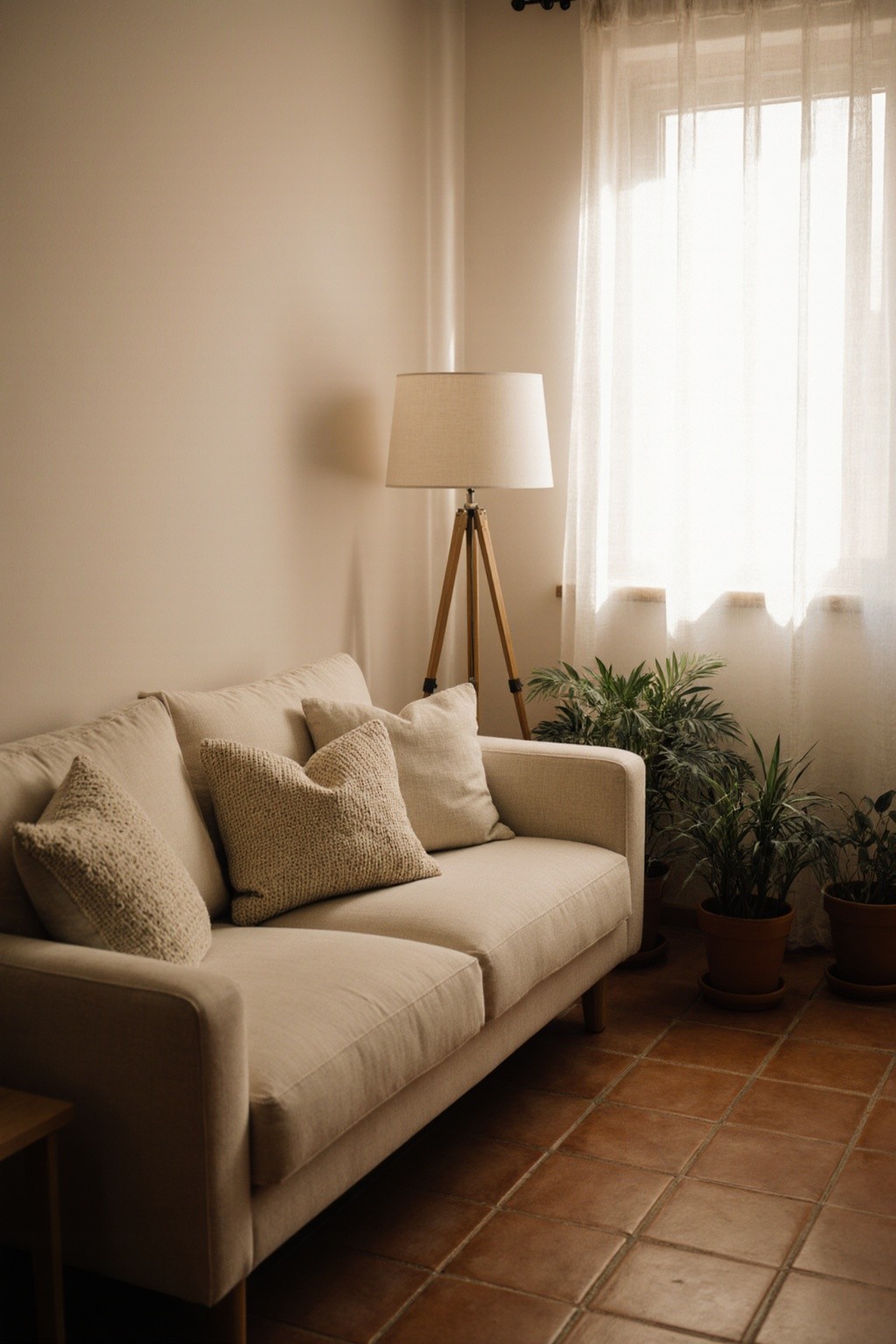
Most people get lighting completely wrong. They install one overhead fixture and call it done, then wonder why their room feels like a doctor’s office. I learned this the hard way after spending two years squinting under a single ceiling light in my living room. The solution is layering—multiple light sources at different heights using natural materials like linen, rattan, or paper.
I added a floor lamp with a cream linen shade in the corner behind my reading chair, and it completely changed how I use that space. The ambient glow makes the room feel cozy after sunset instead of harsh and fluorescent. Target sells decent linen-shade floor lamps for around $60-80, while higher-end versions from Rejuvenation or Schoolhouse run $200-350. The investment matters because cheap shades yellow quickly and don’t diffuse light evenly.
Common mistake: Placing all your lamps at the same height. I keep one floor lamp tall (around 60 inches), one table lamp medium (24 inches), and use candles or small accent lights low. This creates depth and makes your eye move around the room naturally instead of landing on one bright spot.
3. Create a Green Corner with Plants of Varying Heights

Single plants scattered on shelves look lonely and forgettable. I used to do this—one succulent here, one pothos there—and my home still felt empty. Then I grouped five plants together in my living room corner, and suddenly that dead space became the focal point everyone mentions. This clustering approach maximizes the biophilic design benefits that research shows reduce stress and improve air quality.
Start with one tall plant (I use a fiddle leaf fig that’s about 5 feet), add two medium plants at different heights (my snake plant sits on a 12-inch plant stand, my monstera directly on the floor), and finish with two trailing or small plants in the foreground. This creates visual layers that feel intentional. Home Depot and Lowe’s sell most of these for $15-40 each, making this one of the cheapest ways to add life to your space.
Honestly, the maintenance worried me at first. But snake plants and pothos are nearly impossible to kill—I water mine every 10-14 days and they’re thriving. The fiddle leaf fig is fussier and drops leaves if I move it, which taught me to commit to plant placement before buying finicky varieties.

Modern Ceramic Vase Set, Neutral Colors
Modern Ceramic Vase Set punches above its price — 241 buyers rated it 4.5 stars. I would buy it again.
4. Choose One Statement Piece Per Room

I used to think more decoration meant more personality. My shelves were packed with ten small frames, five candles, three vases, and a bunch of stuff I didn’t even like. Then I cleared everything and put one large sculptural vase on my console table. The difference was shocking—the room suddenly looked expensive and intentional instead of cluttered and chaotic.
This approach works because your eye needs somewhere to land. When everything competes for attention, nothing wins. I’ve found that statement pieces work best when they’re either significantly larger than you think you need or have an unusual shape that creates visual interest. A 16-inch ceramic vase makes more impact than five 6-inch ones. A bold sculptural chandelier (I’m obsessed with the organic shapes from West Elm) becomes the room’s personality instead of requiring you to style ten surfaces.
The price point here varies based on your taste. I’ve scored amazing statement pieces at HomeGoods for $40-60, but I’ve also invested $200 in a handmade ceramic piece from a local artist that I’ll keep forever. Start by removing half your current decor and see what happens. You can always add back, but I bet you won’t want to.
5. Install Hidden Storage Solutions

Visible clutter kills coziness faster than anything else. I learned this during a renovation when my contractor suggested building cabinets under my stairs instead of leaving that space empty. I was skeptical about the cost, but those cabinets now hold everything from seasonal decor to extra linens, and my main living areas stay clear without constant organizing.
If you’re not renovating, ceiling-height bookshelves with closed lower cabinets work beautifully. IKEA’s BILLY system with OXBERG doors costs around $200-300 for a full wall setup and looks custom when painted to match your walls. I painted mine the same cream as my living room, and guests assume they’re built-ins. The closed lower sections hide board games, photo albums, and all the random stuff that used to pile on my coffee table.
Pro tip: Install these storage solutions before you think you need them. I waited too long and spent six months tripping over boxes while I saved up for the cabinets. The peace of having everything put away is worth prioritizing in your budget. Even adding one closed storage piece—like a credenza or storage ottoman—immediately makes a room feel more organized and therefore cozier.
6. Use Sheer Fabrics on Windows

Heavy curtains made my bedroom feel like a cave, even during the day. I replaced them with white linen sheers from Pottery Barn (around $100 per panel), and the natural light that filters through completely changed the mood of the space. This supports biophilic design principles by maintaining your connection to the outdoors even when curtains are closed.
The key is choosing sheers that provide privacy without blocking light. I can see shapes and movement through mine, which means I keep them closed during the day for privacy but still get all that beautiful diffused sunlight. At night, I layer them with blackout roller shades that I pull down only for sleeping. This two-layer system gives you control without sacrificing the airy feeling that makes rooms feel larger and more welcoming.
Common mistake: Hanging sheers on those cheap tension rods that sag in the middle. Invest in proper curtain rods mounted above and wider than your window frame. I mount mine 4-6 inches above the window and extend them 6 inches beyond each side. This makes your windows look bigger and your ceilings look higher, which adds to that cozy-but-not-cramped feeling I’m always chasing.

GODONLIF Candle Warmer Lamp with Timer Dimmable
GODONLIF Candle Warmer Lamp with Timer Dimmable punches above its price — 75 buyers rated it 4.5 stars. I would buy it again.
7. Incorporate Decorative Wall Plates

Wall plates are having a moment, and I’m here for it. I started with three vintage plates above my kitchen sink—found them at an estate sale for $5 each—and now I have collections in my dining room and bedroom too. What I love about this trend is that no two plate walls look the same, so you’re guaranteed a unique look that reflects your actual taste instead of copying a showroom.
The beauty of plates is their versatility. They work in literally every room and with every style. I’ve seen them styled traditionally with matching blue and white patterns, eccentrically with mismatched colors and sizes, and minimally with simple white plates in geometric arrangements. Anthropologie sells gorgeous decorative plates for $12-28 each, but honestly, thrift stores and estate sales are where I find the most interesting pieces with actual history.
Hanging them is easier than you think. I use plate hangers with spring closures (buy them in bulk on Amazon for about $1 each) and regular picture hooks. Start with an odd number—three, five, or seven plates—arranged in a cluster rather than a straight line. I sketch my arrangement on paper first, then tape paper templates to the wall before hammering any nails. This saves you from the nightmare of multiple holes in the wrong spots.
8. Mix Multiple Wood Tones for Depth

The matching furniture set is dead, and good riddance. I used to think all my wood needed to match perfectly—my oak dresser, oak nightstands, oak bed frame all bought together. It looked fine but boring, like a hotel room. Then I added a walnut mirror and a lighter maple stool, and suddenly my bedroom had personality and looked collected over time instead of bought in one shopping trip.
The trick is varying the tones enough that it looks intentional. I keep my large furniture pieces (bed, dresser) in similar tones, then add contrast with smaller pieces and decor. My oak dresser pairs beautifully with a darker walnut tray on top and a light bamboo mirror above. This creates visual depth that makes the room feel more interesting without being chaotic.
Pro tip: Include at least three different wood tones in each room. Two tones can look like you tried to match and failed. Three or more looks curated and intentional. I typically work with one light tone (maple or light oak), one medium (natural oak or cherry), and one dark (walnut or mahogany). This gives you enough variety to keep things interesting while maintaining cohesion.
9. Invest in Nature-Mimicking Textured Surfaces

Texture is what separates cozy rooms from flat, boring ones. I added a headboard with recycled cork carved to look like rippling water last year, and it’s the first thing everyone notices in my bedroom. These nature-inspired textures bring organic elements indoors in unexpected ways that feel modern rather than literal or kitschy.
The options here have exploded recently. I’ve seen plaster walls etched to look like tree bark, three-dimensional wallpapers that mimic rock formations, and tile that replicates natural stone so convincingly I had to touch it to tell the difference. What’s cool about these textured surfaces is that many offer sound-dampening properties, which makes rooms feel quieter and more peaceful—a bonus I didn’t expect but now can’t live without.
Prices vary wildly based on what you choose. Textured wallpaper from Tempaper starts around $30 per roll and is renter-friendly since it’s removable. A custom plaster wall treatment runs $15-25 per square foot installed, making it a bigger investment but one that completely transforms a space. I started small with textured throw pillows (West Elm has gorgeous options for $30-50) to test whether I liked the look before committing to walls.

White Ceramic Donut Vase Set of 2
White Ceramic Donut Vase Set of 2 has been one of the most consistently praised picks in this category. 382 reviewers averaged 4.5/5.
10. Use Terracotta Tiles for Warmth

Terracotta tiles give you that lived-in, cozy aesthetic that’s impossible to achieve with stark white or gray tile. I installed terracotta-look porcelain tiles in my entryway (the authentic clay versions were too porous for my high-traffic area), and they make my home feel warm and welcoming the second you walk in. The color variation in each tile adds character that solid-color options can’t match.
Modern terracotta comes in fresh shapes beyond the traditional square. I’ve seen hexagons, elongated rectangles, and even scalloped edges that feel contemporary while maintaining that earthy warmth. Floor & Decor sells porcelain terracotta lookalikes for $3-5 per square foot, while authentic clay tiles from companies like Cle Tile run $15-30 per square foot. The porcelain versions are more practical for most homes—they’re more durable, easier to clean, and don’t require sealing.
Common mistake: Pairing terracotta with too many other warm tones. I balance mine with cool whites and blacks to prevent the space from feeling too orange or muddy. My terracotta floor looks best with white walls and black metal fixtures, which lets the tile be the warm element without overwhelming the space.
11. Display Vintage Wall Art in Gilt Frames

I found a vintage oil painting of a forest landscape at a thrift store for $12, and it’s now the focal point of my living room. Vintage art in ornate gilt frames adds instant character and makes your home feel collected and personal rather than decorated from a single shopping trip. The trend works because it mixes old and new in a way that feels intentional rather than matchy-matchy.
You don’t need authentic antiques to achieve this look. Plenty of retailers sell reproduction vintage art that captures the same moody, atmospheric quality. World Market has framed vintage-style prints for $40-80, while Etsy sellers offer actual vintage pieces ranging from $20 for small prints to several hundred for large oil paintings. I lean toward dark, moody subjects—forest scenes, portraits with interesting faces, or still lifes with dramatic lighting.
The unexpected placement is what makes this trend feel current. Instead of hanging my vintage portrait in the living room where you’d expect it, I propped it on my kitchen counter leaning against the backsplash. This juxtaposition of old art in a utilitarian space feels fresh and keeps the look from being too precious or formal. Try leaning a framed piece on a mantel, dresser, or even the floor against a wall before committing to hanging it.
12. Hand-Stencil Walls or Furniture

I stenciled a simple geometric pattern on my bedroom wall last winter, and it took about four hours total. The result looks custom and expensive, but the supplies cost less than $40 from Michael’s. Hand-stenciling adds what designers call “quiet poetry”—subtle pattern and texture that feels personal and handcrafted rather than mass-produced.
The key is choosing a pattern that’s forgiving. My first attempt with a detailed floral was a disaster because every imperfection showed. I switched to a simple repeating diamond pattern, and the slight variations where my hand wobbled actually add to the handmade charm. Royal Design Studio sells gorgeous stencils for $30-50 that come with detailed instructions. I used regular wall paint in a slightly darker shade than my base color, which creates subtle tone-on-tone pattern.
Pro tip: Practice on poster board first. I wasted half a wall learning how much paint to load on my stencil brush (less than you think—almost dry is better). Once you get the technique down, you can finish a full wall in an afternoon. I’ve also stenciled furniture—a plain IKEA dresser became a statement piece with a Moroccan-inspired pattern on the drawer fronts. It’s a game-changer for updating thrift store finds or boring builder-grade cabinets.

Modern Ceramic Vase Set of 5
A dependable everyday pick — Modern Ceramic Vase Set of 5 pulls in 531 ratings at 4.5 stars. Not flashy, just solid.
13. Create Zoned Built-In Walls

Built-in walls that combine multiple functions are everywhere right now, and after installing one in my living room, I understand why. Mine combines TV storage, open shelving for books and plants, closed cabinets for clutter, and even a small bar area—all in one cohesive unit that spans my entire wall. It looks custom and expensive but cost about $800 in materials using IKEA cabinets as the base.
The magic is in the combination of materials and finishes. I used wood for the open shelving, painted the cabinet doors a warm cream, added black metal hardware, and incorporated a stone-look laminate for the bar section. This variety keeps the large built-in from feeling too heavy or monotonous. The closed storage is crucial—it lets me hide all the ugly stuff (router, cables, random electronics) while displaying only the pretty things on open shelves.
Honestly, this project intimidated me at first. I hired a handyman to help with installation and finishing touches, which added about $400 to the cost but was worth it for the professional result. If you’re handy, IKEA’s BESTÅ system is designed for this type of customization and comes with detailed instructions. The key is planning your layout carefully before buying anything—I sketched mine out three times before committing to measurements.
14. Embrace Bold Cabinet or Wall Colors

I painted my bathroom cabinets electric blue last month, and it required more courage than I expected. Bold, saturated colors like bright lime green, hot pink, or electric blue are trending because they affect your mood in ways that neutral spaces can’t. My blue bathroom makes me smile every morning, which sounds cheesy but is genuinely true.
The commitment level here is real. You can’t half-heartedly commit to electric saturation—it either works because you go all in, or it looks like a mistake. I painted all my lower cabinets the same bold blue and kept the walls white to let the color be the statement. Benjamin Moore’s “Caribbean Blue Water” is the exact shade I used, and I love how it reads as confident rather than childish.
Common mistake: Choosing bold colors without considering undertones. I tested five different blues before finding one that didn’t look purple or green in my lighting. Professional colorists spend hours on this because undertones make or break bold colors. Buy sample pots and paint large swatches on poster board that you can move around the room at different times of day. The color that looks perfect at noon might look terrible at 7 PM under artificial light.
15. Layer Rugs for Texture and Warmth

I layer a smaller vintage rug over my larger jute rug in the living room, and this simple trick adds depth and coziness that one rug alone can’t achieve. The jute provides neutral texture and defines the seating area, while the vintage rug adds color and pattern without overwhelming the space. This layering approach also lets you use smaller rugs, which are cheaper and easier to find in interesting patterns.
The bottom rug should be larger and neutral—jute, sisal, or a simple wool rug in cream or gray. I got my 8×10 jute rug from Rugs USA for around $200. The top rug can be smaller and more interesting—I use a 5×7 vintage Turkish rug that I found on Etsy for $150. The size difference is important; you want at least 6-12 inches of the bottom rug visible on all sides so both rugs register as intentional layers rather than looking like you couldn’t decide.
Pro tip: Make sure your rugs have different textures. My flat-weave vintage rug over chunky jute works because they contrast. Two similar textures just look like you’re trying to cover a stain. I’ve also layered a cowhide over a wool rug, which added an organic element that feels cozy without being too rustic.

Vanselia Ceramic Vase Home Table Decor
A dependable everyday pick — Vanselia Ceramic Vase Home Table Decor – Flower Vases Set of 3 Small L pulls in 362 ratings at 4.5 stars. Not flashy, just solid.
16. Install Dimmer Switches Throughout Your Home

This is the cheapest upgrade that makes the biggest impact. I installed dimmer switches in every room except the kitchen, and it cost about $15 per switch plus an hour of my time (or $50-75 per switch if you hire an electrician). Being able to adjust lighting levels throughout the day makes your home feel cozy and adaptable rather than stuck at one brightness level.
The difference is most noticeable in the evening. Instead of harsh overhead lights that feel like daytime, I dim everything to about 50-60% after sunset. This signals to my brain that it’s time to relax and creates that warm, cozy atmosphere that makes you want to curl up with a book instead of staring at screens. Lutron makes reliable dimmers that work with LED bulbs (important—not all dimmers do) for around $15-20 at Home Depot.
Common mistake: Only dimming overhead lights. I also put my floor lamps and table lamps on dimmers using plug-in dimmer modules (about $10 each on Amazon). This gives you complete control over your lighting layers and lets you create different moods depending on what you’re doing. Movie night needs different lighting than dinner party lighting, and dimmers make those adjustments effortless.
17. Create a Reading Nook with Intentional Lighting

I carved out a reading nook in the corner of my bedroom using just a comfortable chair, a small side table, and a well-placed floor lamp. This dedicated cozy space cost less than $300 total (chair from Facebook Marketplace, lamp from Target, table from HomeGoods) but has become my favorite spot in the house. The key is making it feel separate and intentional rather than just a chair shoved in a corner.
Lighting makes or breaks a reading nook. I use a floor lamp with an adjustable arm that directs light exactly where I need it—over my shoulder onto the page. The Brightech Sky LED Arc Lamp ($70 on Amazon) works perfectly and doesn’t take up floor space since it arcs over the chair. I keep this as the only light source in the nook area, which creates a cozy pool of light that feels separate from the rest of the room.
Add a small side table for your coffee or book, and you’re done. I use a 12-inch round table that’s just big enough for a mug and reading glasses. A soft throw blanket draped over the chair back completes the cozy factor. The whole setup takes up maybe 4 feet by 4 feet of floor space but makes the room feel more functional and personal. This is especially valuable in small spaces where every area needs to serve a purpose.
18. Use Oversized Art Instead of Gallery Walls

I replaced my gallery wall with one large piece of art, and my living room immediately looked more expensive and cohesive. Gallery walls are trendy but tricky—they require perfect spacing and balance, and honestly, most people get them wrong (I definitely did). One oversized piece makes a statement without the fussy arrangement and constant adjusting.
Scale matters more than you think. I went with a 40×60 inch canvas, which felt ridiculously large when I ordered it but looks perfect on my wall. The rule I follow is filling about two-thirds of the wall space above your furniture. So if your sofa is 7 feet wide, your art should be roughly 4-5 feet wide. This creates proper visual weight without overwhelming the space.
Society6 and Minted sell large-scale prints for $150-300, or you can print your own photos through services like Nations Photo Lab for less. I printed a photo I took on vacation as a 40×60 canvas for about $120, and it’s more meaningful than anything I could buy. The large format makes even amateur photography look artistic and intentional. Just make sure your image resolution is high enough—you need at least 100 DPI at the final print size to avoid pixelation.
19. Incorporate Soft, Touchable Textures Everywhere

Cozy is as much about touch as it is about sight. I added a chunky knit throw to my sofa, velvet pillows to my bed, and a sheepskin rug under my desk chair. These soft textures make you want to touch things and settle in, which is the whole point of cozy home decor ideas. Hard, smooth surfaces feel cold and unwelcoming no matter how pretty they look.
I aim for at least three different soft textures in every room. My living room has a bouclé sofa, linen curtains, a jute rug, velvet pillows, and a chunky knit throw. This variety keeps the space interesting and gives you options depending on what you’re doing—the throw for movie nights, the velvet pillows for reading, the bouclé texture just for existing comfortably.
Pro tip: Buy these items seasonally on sale. I stock up on throws and pillows at Target and HomeGoods during their semi-annual sales, paying $15-25 for items that normally cost $40-60. Quality matters for items you’ll touch constantly—cheap velvet pills quickly, and thin throws don’t provide warmth. I’ve learned to invest in fewer, better-quality soft goods rather than buying a bunch of cheap stuff that looks sad after one wash.
20. Display Books as Decor Throughout Your Home

Books make spaces feel lived-in and personal in a way that generic decor objects can’t match. I keep books on my coffee table, nightstand, kitchen counter, and even in my bathroom. They add color, texture, and personality while being functional—unlike decorative objects that just sit there looking pretty but serving no purpose.
The styling matters. I stack books horizontally in groups of three to five, varying the heights and colors to create visual interest. Coffee table books with beautiful covers (I love anything by Assouline or Phaidon) work as decor while giving guests something to flip through. I mix in smaller novels and paperbacks to avoid the overly styled look that screams “I bought these just for decoration.”
Thrift stores and used bookstores are goldmines for decorative books. I look for hardcovers with interesting spines or covers in colors that work with my space. A stack of vintage books with worn covers and aged pages adds character that new books can’t replicate. The cost is minimal—usually $1-3 per book—but the impact is significant. Books make your home feel collected and personal, like someone actually lives there and has interests beyond interior design.
These cozy home decor ideas work because they’re practical and achievable, not aspirational and impossible. Start with one or two that resonate with you, and see how they change the way your space feels. I’m constantly tweaking and adjusting—that’s the fun part. Save this article for when you need inspiration, and remember that cozy is about how your home makes you feel, not how it looks in photos.
Frequently Asked Questions
What makes a home feel cozy?
Cozy homes combine warm lighting, soft textures, natural materials like wood, and personal touches like books and plants. Layering these elements at different heights and avoiding harsh overhead lighting creates an inviting atmosphere. The key is making spaces feel lived-in rather than showroom-perfect.
How can I make my home cozier on a budget?
Start with affordable changes like adding throw blankets ($15-25), layering rugs, installing dimmer switches ($15 each), and grouping thrift store plants together. Swapping out harsh bulbs for warm-toned LEDs and displaying books as decor costs almost nothing but makes a significant impact.
What colors make a room feel cozy?
Warm neutrals like cream, tan, and soft white create cozy foundations. Add warmth through natural wood tones and terracotta accents. Bold colors like electric blue or deep green work when balanced with neutrals. Avoid stark white and cool grays, which feel clinical rather than welcoming.
Should I use overhead lighting or lamps for a cozy space?
Layer multiple light sources instead of relying on overhead fixtures. Use floor lamps, table lamps, and candles at different heights to create ambient glow. Install dimmers on all lights so you can adjust brightness throughout the day. Overhead lights alone feel harsh and institutional.
1 thought on “20 Beautiful Home Decor Ideas for Any Style”