What’s Inside
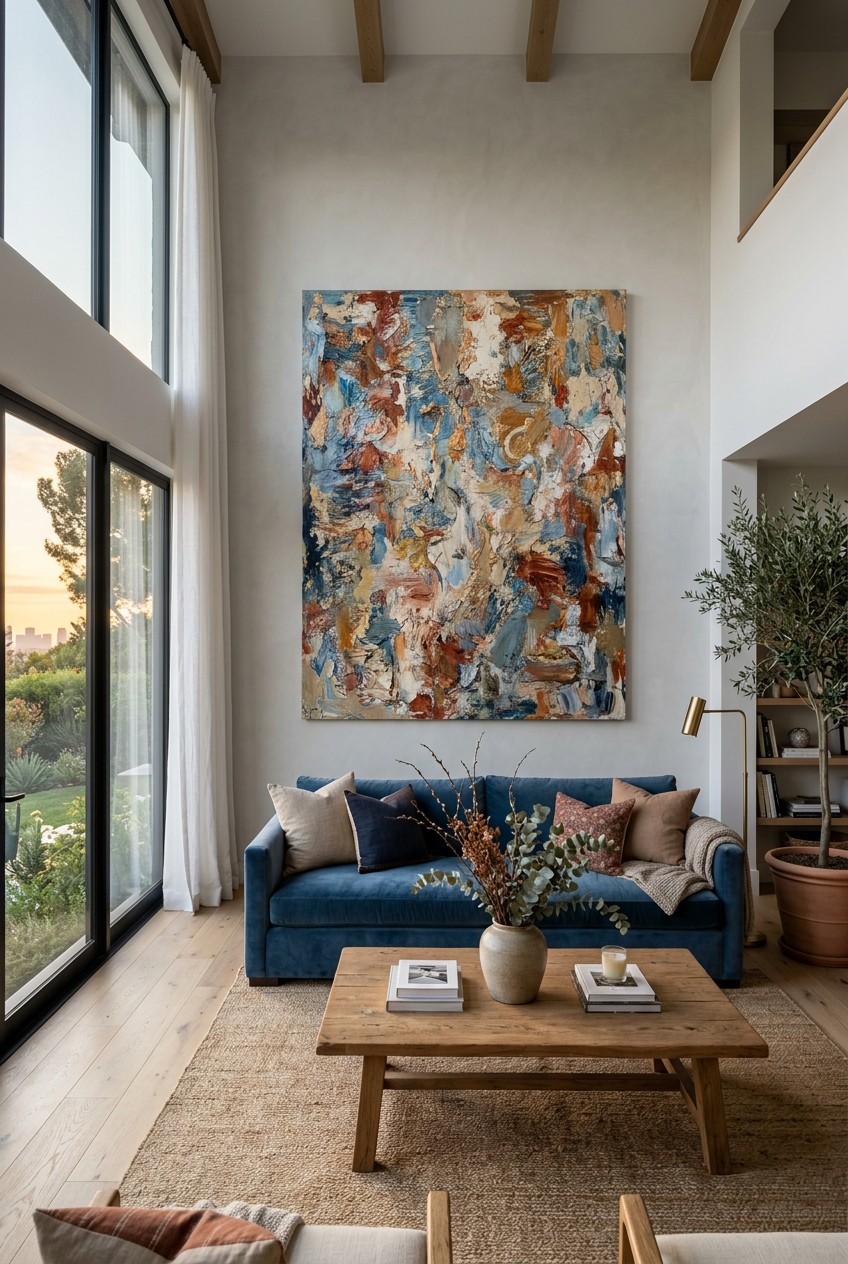
- Embrace Oversized Art as a Singular Statement
- Adhere to the 2/3 Rule for Proportionality
- Master the 57-Inch Eye-Level Rule
- Utilize Large Mirrors to Amplify Space
- Create a Curated Grid Gallery Wall
- Integrate Textured Wall Panels
- Consider Acoustic Art Panels
- Avoid the Too Small Mistake
- Layer with Floating Shelves and Biophilic Elements
- Illuminate Your Art Thoughtfully
- Embrace Intentional Maximalism
- Experiment with Framed Wallpaper Panels
- Don’t Overcrowd the Space
- Integrate a Framed TV as Art
- Flank Art with Tall Greenery
- Hang Oversized Fabric Wall Pieces
- Anchor with a Floating Console
- Make a Statement with an Oversized Clock
- Frame Your Art with Wall Sconces
- Layer Floor Mirrors with Art
I stared at the massive, empty white expanse above my beige sectional for three years before I finally figured out large wall decor living room styling. My first attempt was a complete disaster. I bought a tiny 8×10 canvas from Target on clearance for $5.99, slapped it right in the middle, and it looked like a lonely postage stamp on a billboard. It was embarrassing. If you’re struggling with a giant blank space, you aren’t alone. Tackling large wall decor living room setups is intimidating, but I’ve made all the expensive mistakes so you don’t have to. I’m going to walk you through exactly what works, what to avoid, and the specific pieces I swear by. Let’s fix that boring drywall.
1. Embrace Oversized Art as a Singular Statement

Instead of scattering twenty tiny frames across your drywall, opt for one commanding piece of artwork. I tried the messy gallery wall approach first and it just looked like visual static. Now, I swear by a single large canvas print. A 40×60 inch abstract painting from Yourwallarts or Laboo Studio serves as a powerful focal point above a sofa. These typically run between $100 and $500 depending on the frame quality. I bought a massive moody ocean print for $225 last month and it completely improved my space. The heavy canvas texture feels expensive, and it smells faintly of fresh pine. This approach is a massive trend for 2026. We’re moving away from cluttered walls to clear, impactful statements. Skip the cheap posters. Save up for one giant canvas. It makes the room feel professionally styled.
2. Adhere to the 2/3 Rule for Proportionality

Pro tip: most people get this wrong and end up with artwork that looks entirely lost. When hanging art above heavy furniture like a sectional or a console table, ensure the artwork’s width is about two-thirds to three-quarters the width of the furniture below it. For instance, if you have a standard 84-inch sofa, aim for a single piece or a grouping of art spanning between 56 and 63 inches wide. I learned that the hard way after hanging a 30-inch print over my massive 90-inch basement couch. It looked absolutely ridiculous. I had to patch the holes and start over. Grab a tape measure before you buy anything. Measure the back of your couch, multiply that number by 0.66, and use that as your minimum width guide. It prevents the dreaded postage stamp effect.
3. Master the 57-Inch Eye-Level Rule

If you’re displaying art on a completely blank wall with no furniture underneath it, the center of the artwork needs to be exactly 57 inches from the floor. This is the standard adopted by museums and galleries worldwide. It ensures comfortable viewing at average eye level. I used to eyeball my picture hanging, usually standing on my tiptoes, which meant all my art ended up way too high. My living room felt like a doctor’s waiting room. Last Tuesday at Whole Foods, I was chatting with an interior designer in the checkout line who told me about the 57-inch rule. I went home, ripped down my favorite 24×36 inch floral canvas, and re-hung it at exactly 57 inches on center. The difference is shocking. You don’t have to crane your neck anymore.

Lwenki Key Holder for Wall
Honestly, Lwenki Key Holder for Wall surprised me — sturdier than it looks in the photos, and over 84 buyers gave it 4.5 stars.
4. Utilize Large Mirrors to Amplify Space

I absolutely love using giant mirrors to fake extra square footage. Incorporating an oversized mirror reflects natural light and creates the illusion of a much larger, brighter room. I highly recommend the SVANSELE gold mirror from IKEA for $129.99 or a heavy rectangular mirror from Zara Home. You want a mirror that is at least 30×40 inches to make any real impact. Honestly, this changed how I view my dark north-facing living room. I propped a massive 40×70 inch brass mirror against the wall opposite my only window. Suddenly, the afternoon sunlight bounces right back into the room. The cold glass adds a nice sleek texture against soft velvet sofas. Just make sure it’s reflecting something pretty, like a plant or a nice light fixture, rather than a messy kitchen counter.
5. Create a Curated Grid Gallery Wall

For a highly structured and polished look, design a grid gallery wall using coordinating prints and exactly matching frames. You must maintain consistent spacing of 1 to 3 inches between each piece. I bought nine identical 16×20 inch black frames from Target for $15 each and filled them with black-and-white architectural photos. Before you put a single nail in the wall, lay your entire arrangement out on the living room floor. I skipped this step once, hammered in twelve nails, and realized the whole grid was crooked. I cried out of sheer frustration. Now, I use a laser level and wrapping paper templates taped to the wall. A tight grid is incredibly satisfying to look at, and it fills up a massive wall without feeling chaotic. Just stick to one color palette.
6. Integrate Textured Wall Panels

Flat drywall is boring. A huge trend for 2026 is incorporating tactile design right onto the wall itself. Installing decorative wall panels like wood slats or picture-frame molding adds architectural depth that paint simply can’t achieve. I spent a weekend installing a full feature wall with a square panel design using a $45 molding kit from Home Depot. It was a messy, dusty DIY project, and I definitely got construction adhesive in my hair, but the result is stunning. The raised wood casts actual shadows as the sun moves across the room. It gives the space a high-end, custom-built feel for under $100. If you rent, you can buy lightweight acoustic slat panels that attach with heavy-duty command strips. It breaks up the flat surface beautifully. You might also like: 15 Charming DIY Cozy Apartments Home Decor Ideas for a Fresh New Look

Dog Sculpture Home Decor Cute Man and Dog Statue Decoration
If you want something that just works, Dog Sculpture Home Decor Cute Man and Dog Statue Decoration for Office is a safe bet (326 reviews, 4.5 stars).
7. Consider Acoustic Art Panels

Here is a surprising tip that solves two problems at once. If your living room echoes like an empty gymnasium, you need decorative acoustic panels. Brands like GIK Acoustics or Arturel make heavy, sound-absorbing panels that can be customized with high-resolution printed artwork. They effectively reduce noise while serving as unique art pieces. They typically range from $50 to $300 plus per panel depending on the size. I bought three 24×48 inch panels for $150 each because my kids’ video games were bouncing off the bare walls and giving me a migraine. The panels are thick, covered in a soft felt-like fabric, and they completely deaden the sharp echoes. I chose a muted sage green geometric print. Guests just think it’s modern art. They have no idea it’s actually functional soundproofing. You might also like: 15 Stunning Aesthetic Home Decor Ideas You Need to See
8. Avoid the Too Small Mistake

This is the most common decorating pitfall I see. Hanging art that is disproportionately small for the wall or the furniture below it ruins the entire room’s scale. A tiny 16×20 inch print floating above an 84-inch sectional sofa will appear totally insignificant and disconnected. I did this in my first apartment. I loved this little $12 watercolor print I found at a craft fair, so I proudly hung it over my massive hand-me-down couch. It looked like a mistake. The negative space swallowed it whole. Always choose larger pieces to properly fill the space. If you absolutely must use a small piece of art because it holds sentimental value, put it in an oversized frame with an extra-wide, custom 5-inch matte. This tricks the eye into thinking the piece is much larger. You might also like: 20 Creative Modern Home Decor Ideas for a Fresh New Look
9. Layer with Floating Shelves and Biophilic Elements

Installing floating shelves is a fantastic way to break up a large expanse of wall without committing to massive artwork. I grab heavy wooden floating shelves from West Elm (usually around $100 for a 48-inch shelf) and stagger them. Style them with a mix of hardcover books, textured ceramic vases, and trailing plants. I bought a lush Pothos from Trader Joe’s last week for $7.99, and its long green vines drape beautifully over the edge of the walnut shelf. Adding real plants brings a biophilic touch to the room, aligning perfectly with 2026 trends that focus on natural materials. Just be careful with watering. I accidentally overflowed my watering can once and ruined a stack of vintage magazines sitting below the plant. Now, I always take the plastic nursery pots down to the sink.

UTTCMK Bookshelf Decor Thinker Statue
UTTCMK Bookshelf Decor Thinker Statue – Abstract Art Reading Thinker S has been one of the most consistently praised picks in this category. 771 reviewers averaged 4.5/5.
10. Illuminate Your Art Thoughtfully

Proper lighting is absolutely crucial to showcasing your large pieces. You can’t just rely on your terrible overhead ceiling fan light. Position your artwork where natural light can reach it gently, but avoid direct afternoon sunlight to prevent the colors from fading. I supplement my natural light with dedicated, battery-operated picture lights from Amazon. I bought a sleek brass one for $35.99 that mounts right to the frame. It casts a warm, moody glow over my canvas at night. Warm or adjustable lighting emphasizes the texture and depth of dark, dramatic canvases. The first time I turned on a picture light over my cheap thrifted oil painting, it instantly looked like it belonged in a museum. The thick globs of oil paint caught the light beautifully. Skip the cold, blue-toned LED bulbs.
11. Embrace Intentional Maximalism

We’re moving far away from stark, sterile minimalism. The 2026 trends favor expressive layering and curated spaces that reflect your actual personality. It’s called intentional maximalism. You mix scales and mediums on the same wall. I love combining large ArtFab fabric prints (around $85) with bright acrylic or neon art to create a rich, lived-in feel. I have a massive vintage botanical print layered slightly behind a custom pink neon sign that says ‘Stay Awhile’. It sounds chaotic, but it works because the colors tie together. My mistake early on was buying a bunch of random cheap items that had zero connection to each other. It just looked like a yard sale. To pull this off, you need a strict color palette. Stick to three main colors and let your textures do the work.
12. Experiment with Framed Wallpaper Panels

If you’re hesitant about wallpapering an entire room, try framing large sections of a bold, patterned wallpaper instead. This provides the massive visual impact of a mural with way less commitment. I bought a roll of dark floral peel-and-stick wallpaper from Spoonflower for $45. Instead of putting it directly on the drywall, I applied it to a 4×8 foot piece of smooth plywood, trimmed it with cheap pine molding, and leaned it against my living room wall. It smells slightly of fresh ink and wood, and it looks incredible. It allows for easy layering with art or picture lights. When I inevitably get sick of the pattern in two years, I can just take the board down. It’s the perfect renter-friendly hack for filling a giant wall without losing your security deposit.

WIPHANY Entryway Wall Key Holder with 5 Hooks
WIPHANY Entryway Wall Key Holder with 5 Hooks has been one of the most consistently praised picks in this category. 47 reviewers averaged 4.5/5.
13. Don’t Overcrowd the Space

While large walls can handle significant decor, you must resist the urge to fill every single available inch. Your eyes need somewhere to rest. Leave adequate breathing room around individual artworks and between gallery wall pieces. You want at least 2 to 3 inches of blank space to ensure each element stands out. The overall look needs to remain cohesive, not cluttered. I used to cram as much as possible onto my walls. I’d shove tiny mirrors into any gap I could find. It felt claustrophobic. Taking down about thirty percent of my decor actually made the remaining pieces look more expensive. Negative space is a design tool, not an enemy. Let the blank drywall act as a thick matte for your room. If you bump into frames when you walk past, you have too much stuff.
14. Integrate a Framed TV as Art

Let’s be honest, a giant black plastic rectangle ruins the aesthetic of a carefully styled living room. For a sleek, modern approach, I highly recommend a Samsung Frame TV. I finally bought the 65-inch version for $1,999 during a holiday sale. When turned off, it displays high-resolution artwork and smoothly blends into your decor. The matte screen finish genuinely looks like canvas, not glass. I flank it with brass wall sconces to further improve its appearance and create a sophisticated focal point. The only negative is the clunky One Connect box that you have to hide inside a media console. I spent three hours trying to fish that thick cord through my wall, sweating and swearing the whole time. But once it’s set up, it’s magical. You get your giant TV without sacrificing your wall design.
15. Flank Art with Tall Greenery

For a balanced and natural aesthetic, place tall potted plants on either side of a large artwork or a console table. I bought a massive 6-foot Fiddle Leaf Fig from Costco for $49.99 and a spiky Dracaena from a local nursery. Putting these on the outer edges of my main wall arrangement adds vertical interest, gorgeous leafy texture, and a touch of biophilic design. It naturally draws the eye upwards. Plus, the smell of damp potting soil after watering day is incredibly grounding. I will warn you, my Fiddle Leaf Fig dropped half its leaves when I first brought it home because it hated the draft from my front door. They are dramatic plants. But once it settled in, the dark green leaves perfectly framed my light oak wood art frames.

Homedics Tabletop Water Fountain
Homedics Tabletop Water Fountain has been one of the most consistently praised picks in this category. 437 reviewers averaged 4.5/5.
16. Hang Oversized Fabric Wall Pieces

Large textiles are a fantastic, budget-friendly way to cover a massive wall. I found a gorgeous, heavy woven cotton wall hanging at Target for $45. It’s essentially a giant modern quilt, measuring 50×60 inches. Hanging fabric instantly warms up a cold, echoey room. The soft texture contrasts beautifully with hard leather sofas and glass coffee tables. I initially tried hanging it with basic thumbtacks, and it sagged terribly in the middle, looking like a cheap dorm room. I finally bought a proper wooden dowel rod for $4 from a craft store and threaded it through the top hem. I suspended the rod with two heavy-duty command hooks. It hangs perfectly straight now and gives off a relaxed, bohemian vibe. It’s also incredibly lightweight, so you don’t have to worry about finding wall studs.
17. Anchor with a Floating Console

Sometimes the best way to handle a large wall is to break it in half horizontally. I installed a long, floating IKEA Besta console (around $250 total with doors) about 12 inches off the floor. This grounds the wall and gives you a solid base to work from. Then, I leaned a large 30×40 inch abstract canvas right on top of the console. I paired it with two chunky woven storage baskets from Walmart ($19.98 each) tucked underneath the floating cabinet. The baskets smell like natural seagrass and hide all my ugly router cables. Pro tip: don’t mount the console too high. I originally hung mine at 24 inches, and it completely threw off the proportions of my couch. Keep it low to the ground. It elongates the room and makes the ceilings feel taller.
18. Make a Statement with an Oversized Clock

I know some people think giant clocks are outdated, but a sleek, minimalist metal clock can look incredibly chic on a large blank wall. I was doing a quick grocery run at Kroger last month and stumbled into their home goods aisle. They had a massive 36-inch matte black metal skeleton clock for $60. It has no backing, just the thin metal Roman numerals, so the wall color peeks through. I hung it above my entryway bench, and it acts as both art and function. The only downside is the ticking sound. I bought one a few years ago that ticked so loudly I could hear it from my bedroom. I had to rip the battery out. Always check if the clock has a silent, sweeping second hand before you commit to hanging it.
19. Frame Your Art with Wall Sconces

If your large art still feels a little lonely on a giant wall, flank it with matching wall sconces. You don’t even need an electrician for this anymore. I bought a pair of plug-in brass sconces from Amazon for $65. I mounted them exactly 10 inches on either side of my main canvas. I hid the cords behind a tall vase of fresh eucalyptus I picked up at Sprouts. The symmetry of the sconces instantly widens the visual footprint of the art, making it feel substantial enough to hold the wall. The soft, warm light from the bulbs creates a cozy, high-end hotel vibe. I made the mistake of using bright daylight bulbs at first, and my living room felt like a surgical theater. Always buy bulbs labeled ‘warm white’ or 2700K.
20. Layer Floor Mirrors with Art

My final trick for a massive, intimidating wall is to layer a giant floor mirror directly behind a smaller pedestal or plant stand holding art. I found an amazing 7-foot arched mirror at Sam’s Club for $149, an absolute steal compared to the Anthropologie version. I leaned it securely against the wall. Then, I placed a heavy marble side table slightly in front of it, topped with a framed 11×14 inch vintage sketch and a trailing ivy plant. The mirror reflects the back of the frame and the plant leaves, creating incredible depth. It tricks your brain into thinking the room keeps going. Just ensure you anchor the mirror to the wall with heavy-duty straps. I skipped this step once, and my dog bumped it. Catching a 70-pound mirror before it shatters is not fun. No exaggeration.
There you have it. Tackling a massive, blank wall doesn’t have to end in tears and spackle. Whether you invest in a giant canvas, install acoustic panels, or fake architectural details with wood trim, the secret is scale and intentionality. Don’t let that empty drywall intimidate you into buying twenty tiny, disconnected frames. Go big, measure twice, and let your personality show. I personally swear by the oversized canvas and picture light combo. It’s foolproof. If you try any of these large wall decor living room ideas, let me know how it goes! Don’t forget to save and pin this post so you have all these measurements handy for your next weekend project.
Frequently Asked Questions
How big should art be over a sofa on a large wall?
Always use the 2/3 rule. The artwork or gallery grouping should be roughly two-thirds to three-quarters the width of the sofa below it. For an 84-inch sofa, look for art spanning 56 to 63 inches.
How high should I hang large wall decor living room pieces?
If there is no furniture below the art, hang it so the center of the piece is exactly 57 inches from the floor. This is the standard gallery height that comfortably meets average human eye level.
What is the most affordable way to cover a massive living room wall?
Hanging large textiles or oversized fabric prints is extremely cost-effective. You can also use peel-and-stick wallpaper framed with cheap pine molding to create a massive faux mural without spending hundreds on canvas art.
Can I put multiple large pieces on one living room wall?
Yes, but you must leave adequate breathing room. Keep at least 2 to 3 inches of blank space between large pieces to ensure the wall doesn’t feel cluttered or claustrophobic.
